New Year Sale 70% Discount Offer - Ends in 0d 00h 00m 00s - Coupon code: clap70

NSE6_SDW_AD-7.6 Fortinet NSE 6 - SD-WAN 7.6 Enterprise Administrator Questions and Answers

Questions 4

(Refer to the exhibits.

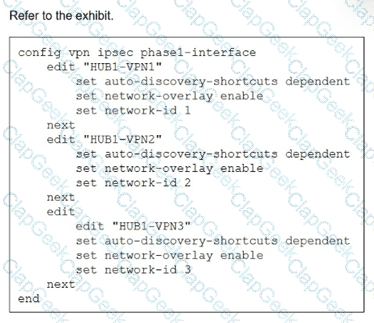
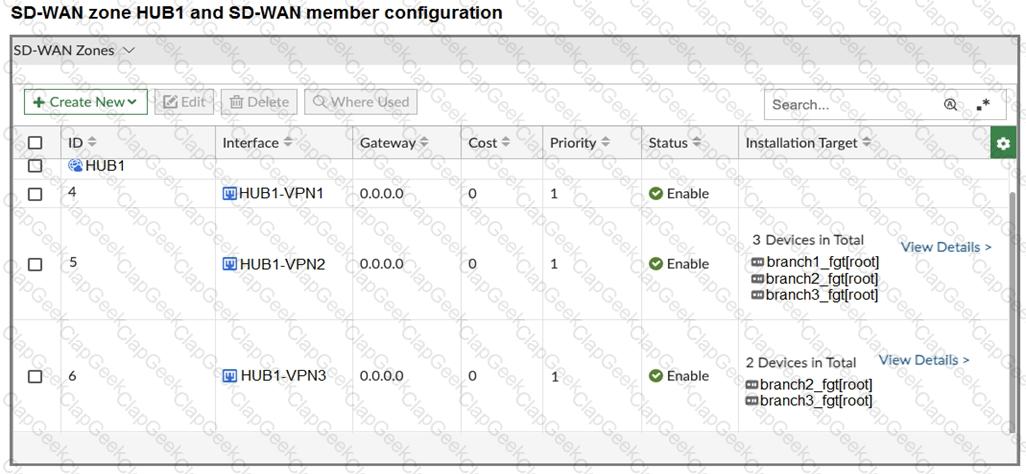
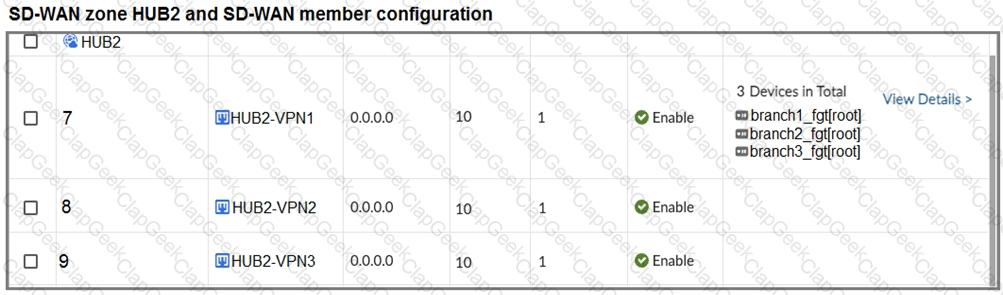
The SD-WAN zones and members configuration of two branch devices are shown. The two branch devices are part of the same hub-and-spoke topology and connect to the same hub. The devices are configured to allow Auto-Discovery VPN (ADVPN). The configuration on the hub allows the initial communication between the two spokes.

When traffic flows require it, between which interfaces can the devices establish shortcuts? Choose one answer.)

Options:

A.

Any interface in the overlay zones

B.

Interface connected to HUB only

C.

Between T3 on Branch-A and TC on Branch-B

D.

Between T2 on Branch-A and TA on Branch-B

Buy Now
Questions 5

Refer to the exhibits.

The exhibits show an SD-WAN event log, the member status, and the SD-WAN rule configuration.

Which two conclusions can you draw from the information shown? (Choose two.)

Options:

A.

The administrator configured the service ID 1 with the highest priority member for port2.

B.

Port2 has a lower latency than port1.

C.

FortiGate updated the outgoing interface list on the rule so it prefers port2.

D.

The administrator configured the SD-WAN rule ID 1 with the default strategy mode.

Buy Now
Questions 6

Refer to the exhibits.

The interface details, static route configuration, and firewall policies on the managed FortiGate device are shown.

You want to configure a new SD-WAN zone, named Underlay, that contains the interfaces port1 and port2.

What must be your first action?

Options:

A.

Define port1 as an SD-WAN member.

B.

Delete the static routes.

C.

Delete the SD-WAN Zone Test.

D.

Delete the firewall policies.

Buy Now
Questions 7

Exhibit.

The administrator configured the IPsec tunnel VPN1 on a FortiGate device with the parameters shown in exhibit.

Based on the configuration, which three conclusions can you draw about the characteristics and requirements of the VPN tunnel? (Choose three.)

Options:

A.

The tunnel interface IP address on the spoke side is provided by the hub.

B.

The remote end can be a third-party IPsec device.

C.

The administrator must manually assign the tunnel interface IP address on the hub side

D.

The remote end must support IKEv2.

E.

This configuration allows user-defined overlay IP addresses.

Buy Now
Questions 8

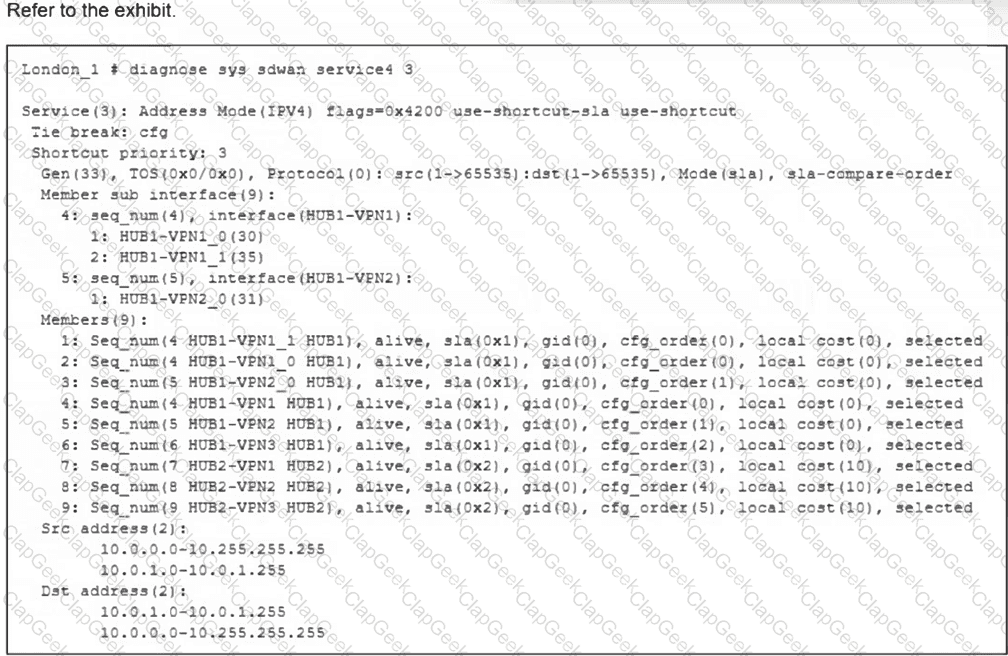
Exhibit.

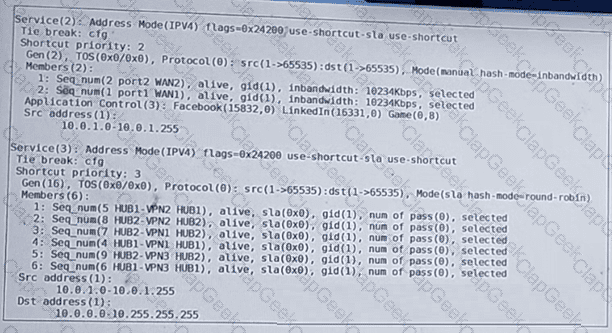
Refer to the exhibit, which shows the SD-WAN rule status and configuration.
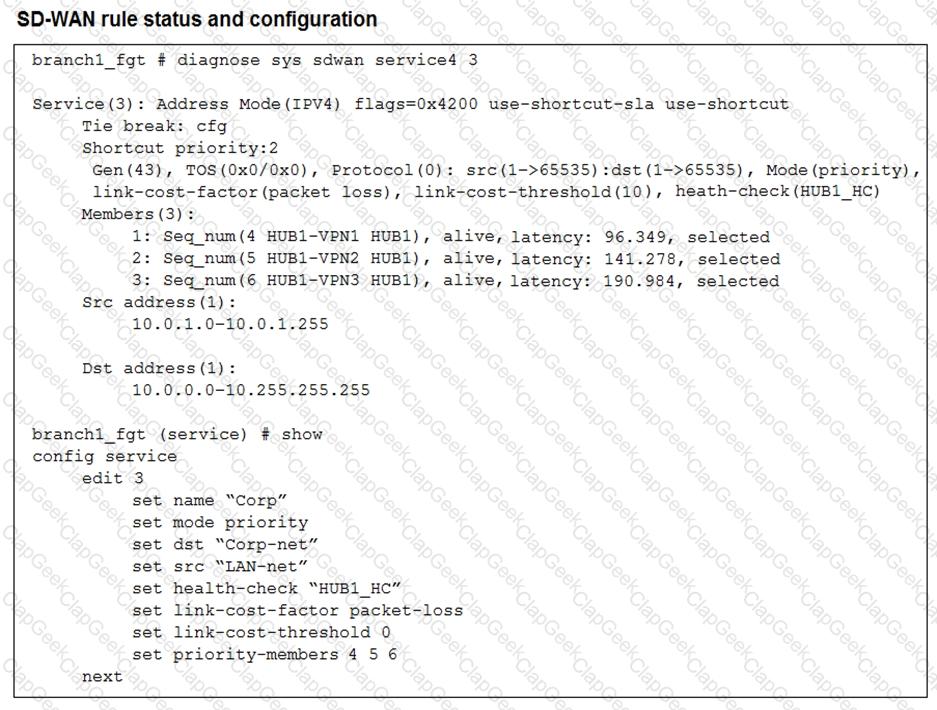
Based on the exhibit, which change in the measured packet loss will make HUB1-VPN3 the new preferred member?

Options:

A.

When HUB1-VPN1 has 4% packet loss

B.

When HUB1-VPN1 has 12% packet loss

C.

When HUB1-VPN3 has 4% packet loss

D.

When all three members have the same packet loss

Buy Now
Questions 9

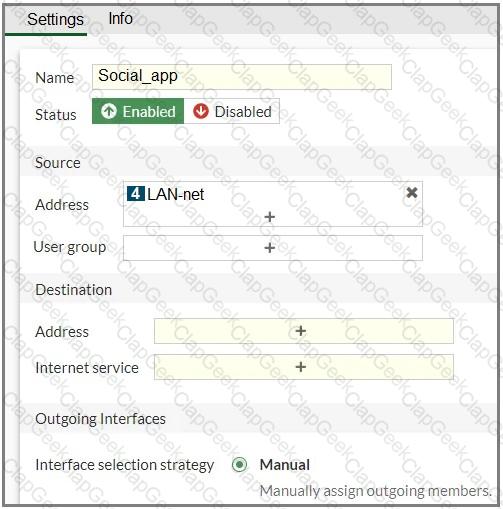
Refer to the exhibit.

You configure SD-WAN on a standalone FortiGate device. You want to create an SD-WAN rule that steers Facebook and Linkedin traffic through the less costly internet link. The FortiGate GUI page appears as shown in the exhibit.

What should you do to set Facebook and LinkedIn as destinations?

Options:

A.

Install a license to allow applications as destinations of SD-WAN rules.

B.

In the Internet service field, select Facebook and LinkedIn.

C.

Enable the applications as destinations of the SD-WAN rule feature visibility.

D.

You cannot configure applications as destinations of an SD-WAN rule on a standalone FortiGate device.

Buy Now
Questions 10

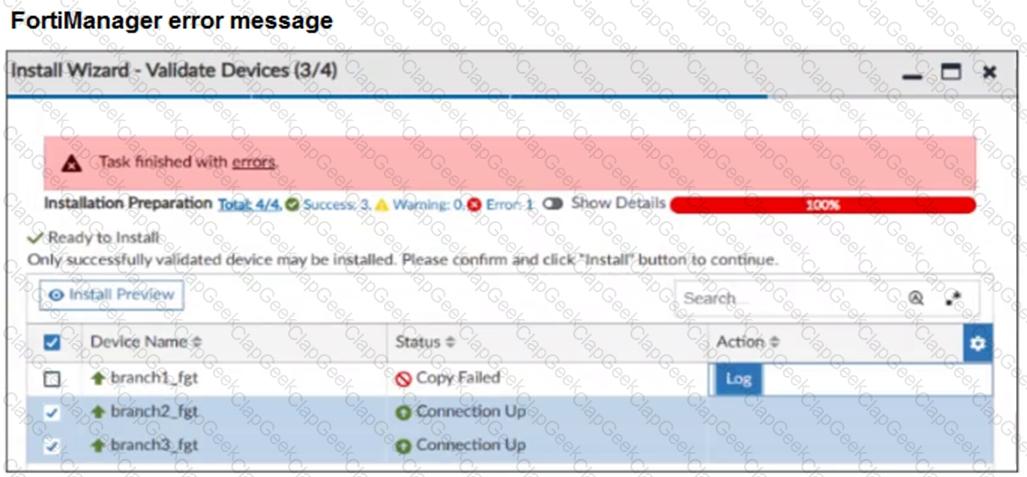
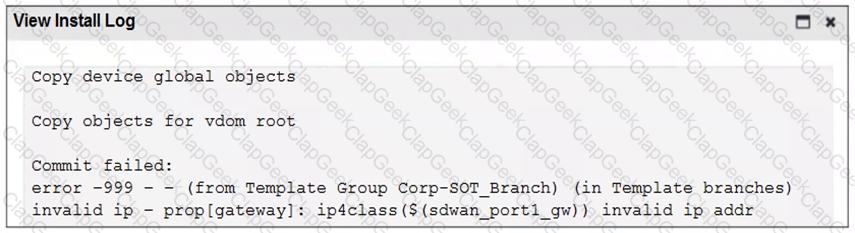
Refer to the exhibits.

You use FortiManager to configure SD-WAN on three branch devices.
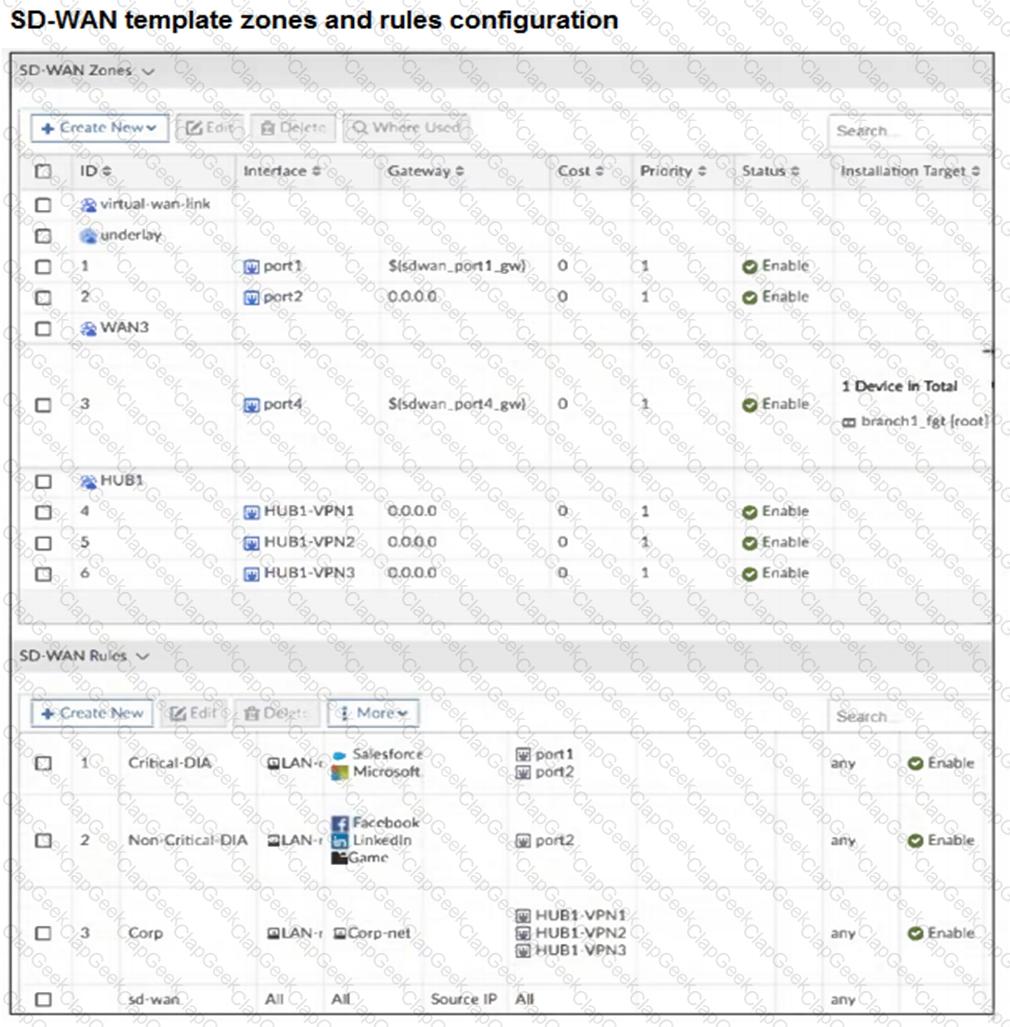
When you install the device settings. FortiManager prompts you with the error "Copy Failed" for the device branch1_fat When you click the log button. FortiManager displays the message shown in the exhibit.

Options:

A.

Based on the exhibits, which statement best describes the issue and how you can resolve it?

B.

Remove the installation target for the SD-WAN member port4. You cannot combine metadata variable and installation targets.

C.

Gateways for all members in a zone must be defined the same way. Specify the gateway of the SD-WAN member port! without metadata variables.

D.

Check the metadata variable definitions, and review the per-device mapping configuration.

E.

Check the connection between branch1_fgt and FortiManager

Buy Now
Questions 11

(You are configuring SD-WAN to load balance network traffic and you want to take into account the link quality.

Which two facts should you consider? Choose two answers.)

Options:

A.

When applicable, FortiGate load balances the traffic through all members that meet the SLA target.

B.

You can select the best quality strategy and allow SD-WAN load balancing.

C.

You can select the lowest cost service level agreement (SLA) strategy and allow SD-WAN load balancing.

D.

The best quality strategy supports only the round-robin hash mode.

Buy Now
Questions 12

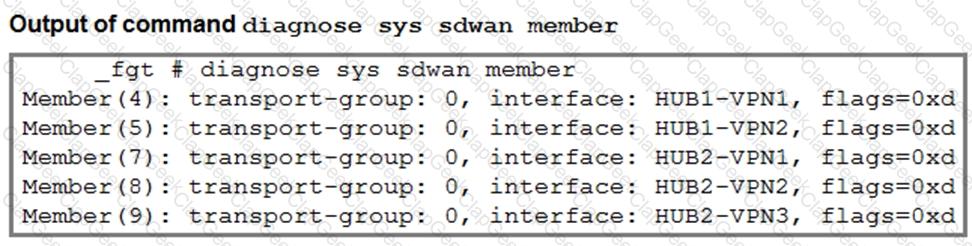
The FortiGate devices are managed by ForliManager, and are configured for direct internet access (DIA). You confirm that DIA is working as expected for each branch, and check the SD-WAN zone configuration and firewall policies shown in the exhibits.

Then, you use the SD-WAN overlay template to configure the IPsec overlay tunnels. You create the associated SD-WAN rules to connect existing branches to the company hub device and apply the changes on the branches.

After those changes, users complain that they lost internet access. DIA is no longer working.

Based on the exhibit, which statement best describes the possible root cause of this issue?

Options:

A.

The SD-WAN overlay template defines a zone for each underlay interface and moves the interfaces into those zones.

B.

The SD-WAN overlay template didn’t configure a firewall policy to allow traffic through the overlay.

C.

The SD-WAN overlay template redefines the interface gateway addresses if they are defined with metadata variables.

D.

The SD-WAN overlay template updates the SD-WAN template and the rules.

Buy Now
Questions 13

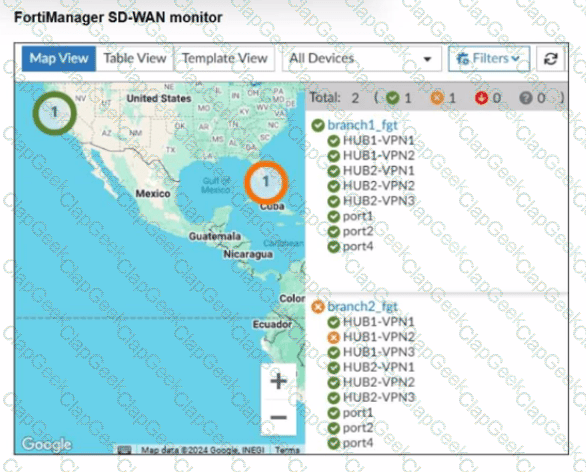
Refer to the exhibit.

An administrator checks the status of an SD-WAN topology using the FortiManager SD-WAN monitor menus. All members are configured with one or two SLAs.

Which two conclusions can you draw from the output shown? (Choose two.)

Options:

A.

The template view should be used to see the hub devices.

B.

One member of branch2_fgt is missing the SLAs.

C.

branch2_fgt establishes six tunnels to the hubs and they are all up.

D.

This SD-WAN topology contains only two branch devices.

Buy Now
Questions 14

Refer to the exhibit.

The administrator configured the SD-WAN rule ID 4 with two members (port1 and port2) and strategy lowest cost (SLA).

What are the two characteristics of the session shown in the exhibit? (Choose two.)

Options:

A.

FortiGate steered this flow according to an SD-WAN rule 4.

B.

FortiGate will never re-evaluate this session.

C.

FortiGate steered this flow according to the application detected and the outgoing interface is port3.

D.

FortiGate will re-evaluate this session if the outgoing interface goes down.

Buy Now
Questions 15

Refer to the exhibit.

How does FortiGate handle the traffic with the source IP 10.0.1.130 and the destination IP 128.66.0 125?

Options:

A.

FortiGate drops the traffic flow.

B.

FortiGate routes the traffic flow according to the forwarding information base (FIB).

C.

FortiGate load balances the traffic flow through port7 and port8.

D.

FortiGate steers the traffic flow through port7.

Buy Now
Questions 16

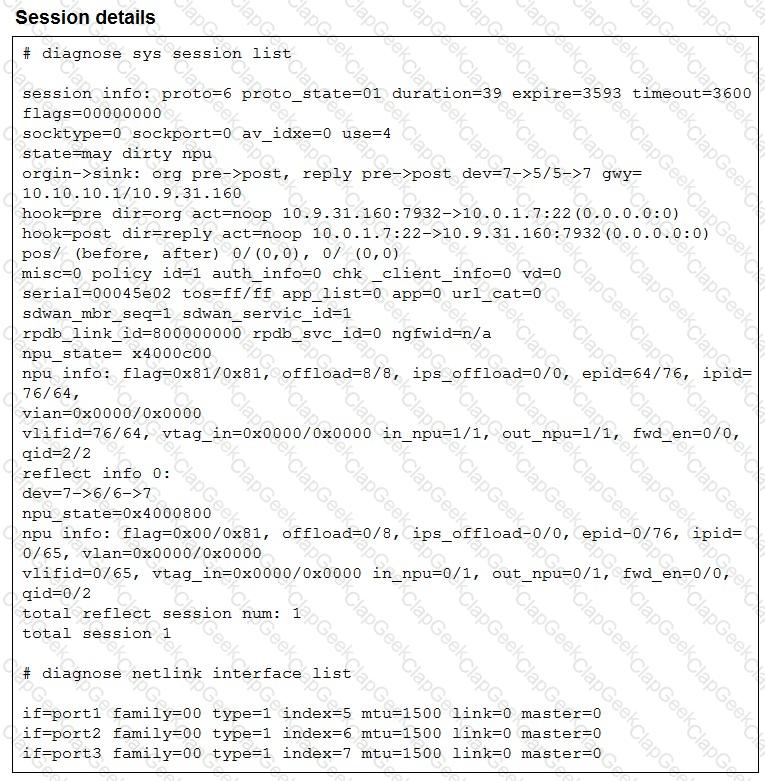
(Refer to the exhibit. You noticed that one SD-WAN member went down and you immediately collected the session output shown in the exhibit. What can you conclude from this output? Choose one answer.)

Options:

A.

FortiGate didn’t receive any traffic related to this session after the interface went down.

B.

FortiGate flushed the gateway for the session.

C.

FortiGate cannot reevaluate the session.

D.

FortiGate already reevaluated this session.

Buy Now
Questions 17

(Refer to the exhibits.

The SD-WAN overlay template advanced settings and the underlay and network advertisement settings are shown. These are the configurations for the secondary hub of a dual-hub SD-WAN topology created with the FortiManager SD-WAN overlay orchestrator.

Which two conclusions can you draw from the information shown in the exhibits? Choose two answers.)

Options:

A.

FortiManager will define port2 as a BGP neighbor.

B.

FortiManager will create an overlay tunnel on the port2 interface.

C.

FortiManager will create an overlay tunnel on the port1 interface.

D.

FortiManager will define port5 as a BGP neighbor.

Buy Now
Questions 18

SD-WAN interacts with many other FortiGate features. Some of them are required to allow SD-WAN to steer the traffic.

Which three configuration elements that you must configure before FortiGate can steer traffic according to SD-WAN rules? (Choose three.)

Options:

A.

Firewall policies

B.

Interfaces

C.

Security profiles

D.

Traffic shaping

E.

Routing

Buy Now
Questions 19

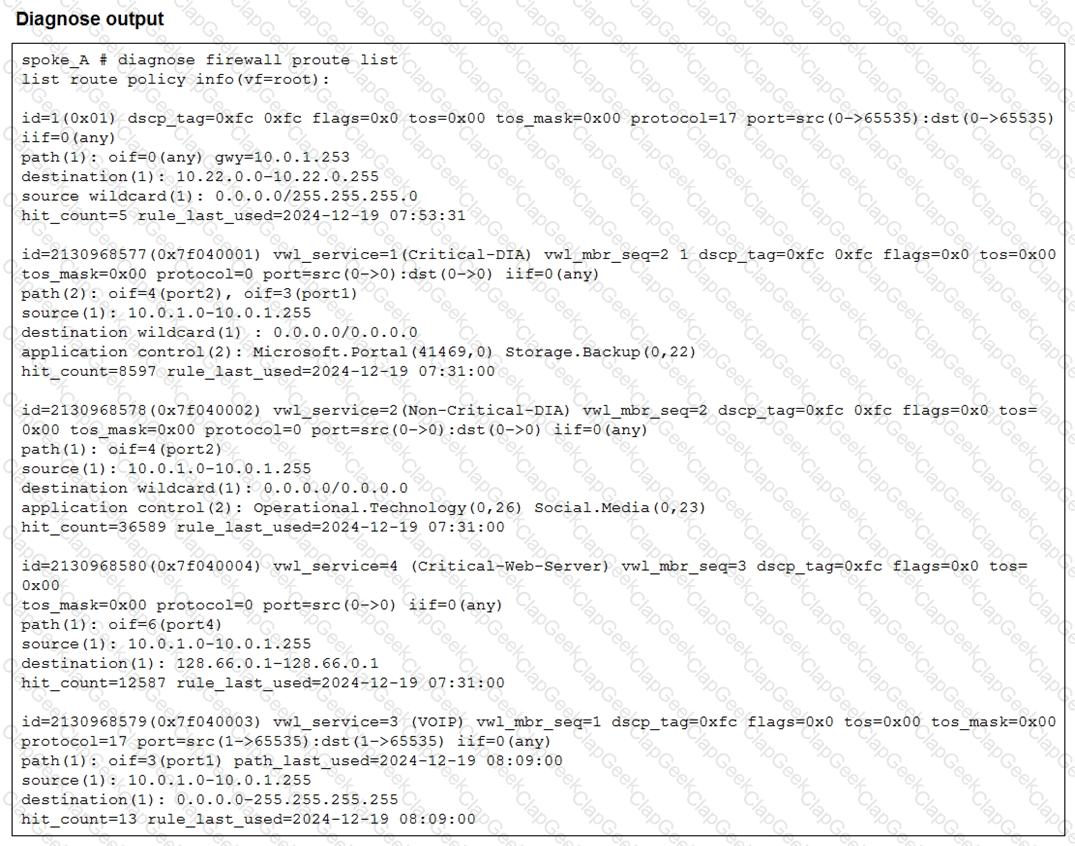
(Refer to the exhibit.

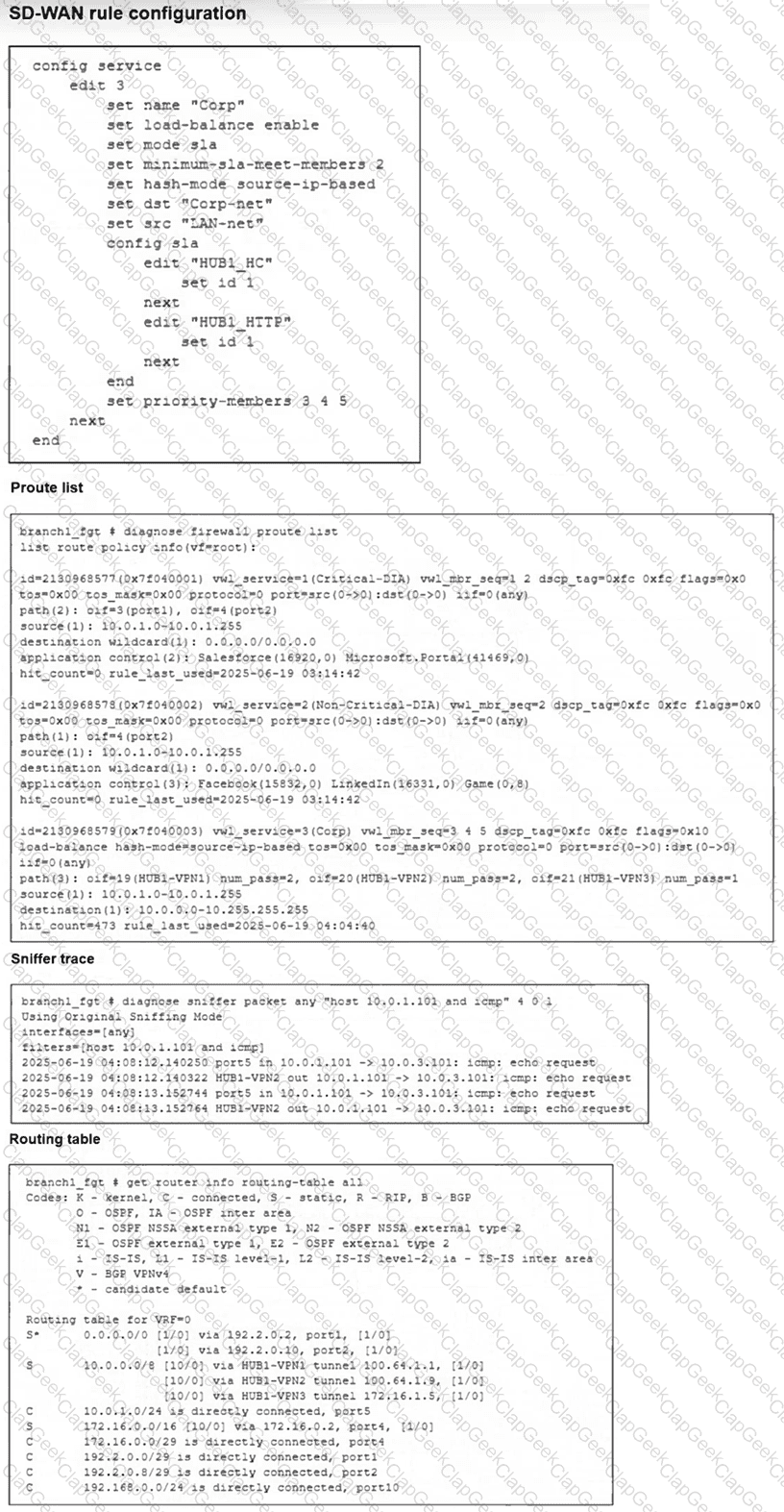
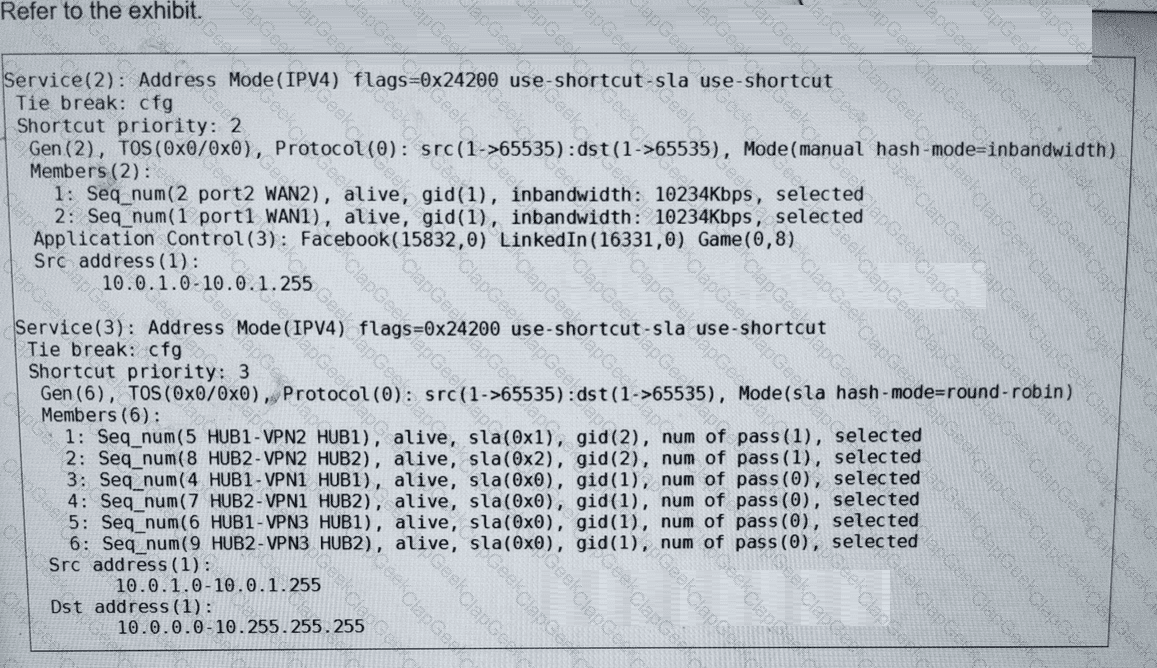
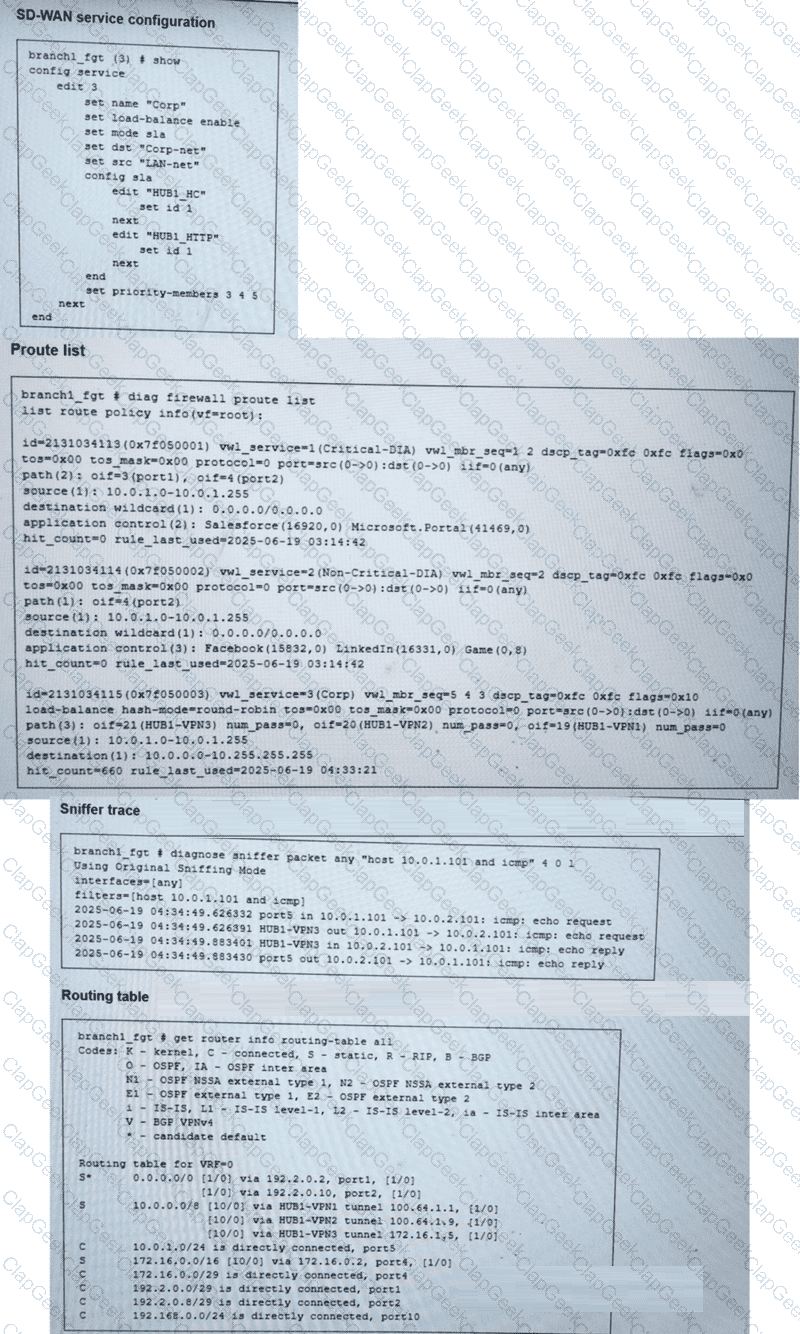
The administrator configured two SD-WAN rules to load balance traffic.

Which interfaces does FortiGate use to steer the traffic from 10.0.1.124 to 10.0.0.254? Choose one answer.)

Options:

A.

port1 or port2

B.

FortiGate routes the traffic according to the FIB.

C.

HUB1-VPN2

D.

Any interface in the HUB1 or HUB2 zones

Buy Now
Questions 20

Refer to the exhibit.

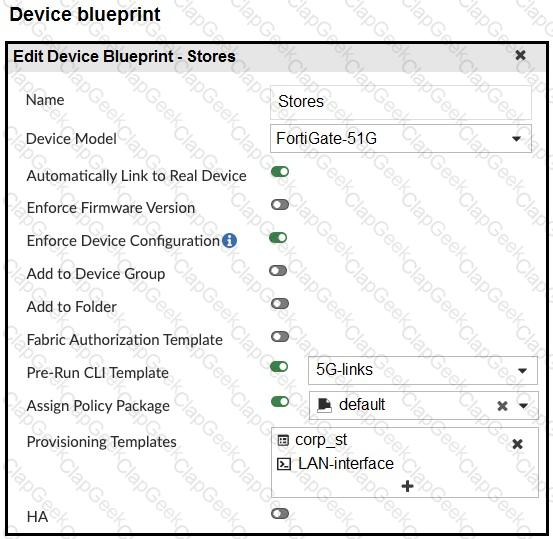
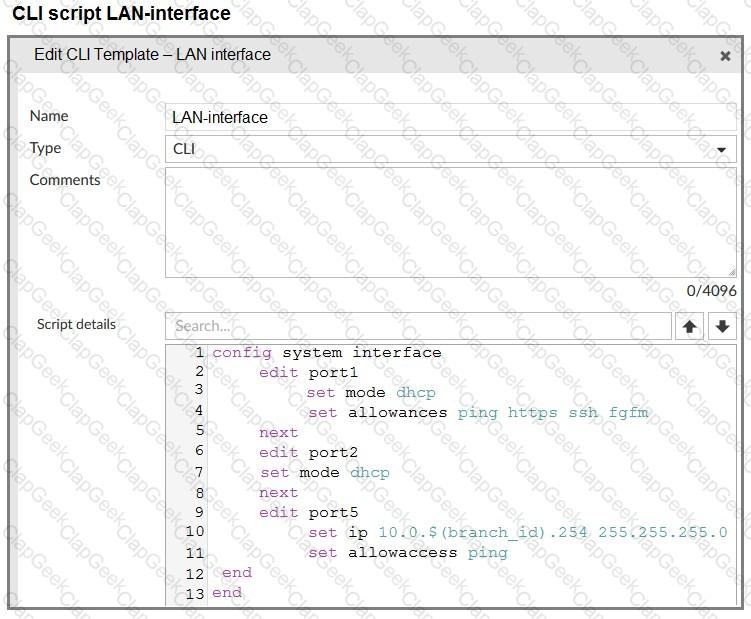
The administrator used the SD-WAN overlay template to prepare an IPsec tunnels configuration for a hub-and-spoke SD-WAN topology. The exhibit shows the FortiManager installation preview for one FortiGate device.

Based on the exhibit, which statement best describes the configuration applied to the FortiGate device?

Options:

A.

It is a spoke device that establishes dynamic IPsec tunnels to the hub. The local subnet range is 10.10.128.0/23.

B.

It is a hub device. It can send ADVPN shortcut offers.

C.

It is a hub device. It will automatically discover the spoke devices and add them to the SD-WAN topology.

D.

It is a spoke device that establishes dynamic IPsec tunnels to the hub It can send ADVPN shortcut requests.

Buy Now
Questions 21

(Which two features must you configure before FortiGate can steer traffic according to SD-WAN rules? Choose two answers.)

Options:

A.

Security profiles

B.

Underlay links

C.

Overlay links

D.

Traffic shaping

E.

Firewall policies

Buy Now
Questions 22

You have a FortiGate configuration with three user-defined SD-WAN zones and two members in each of these zones. One SD-WAN member is no longer in use in health-check and SD-WAN rules. You want to delete it.

What happens if you delete the SD-WAN member from the FortiGate GUI?

Options:

A.

FodiGate accepts the deletion and removes routes as required.

B.

FortiGate displays an error message. You must use the CLI to delete an SD-WAN member.

C.

FortiGate displays an error message. SD-WAN zones must contain at least two members

D.

FortiGate accepts the deletion and places the member in the default SD-WAN zone.

Buy Now
Questions 23

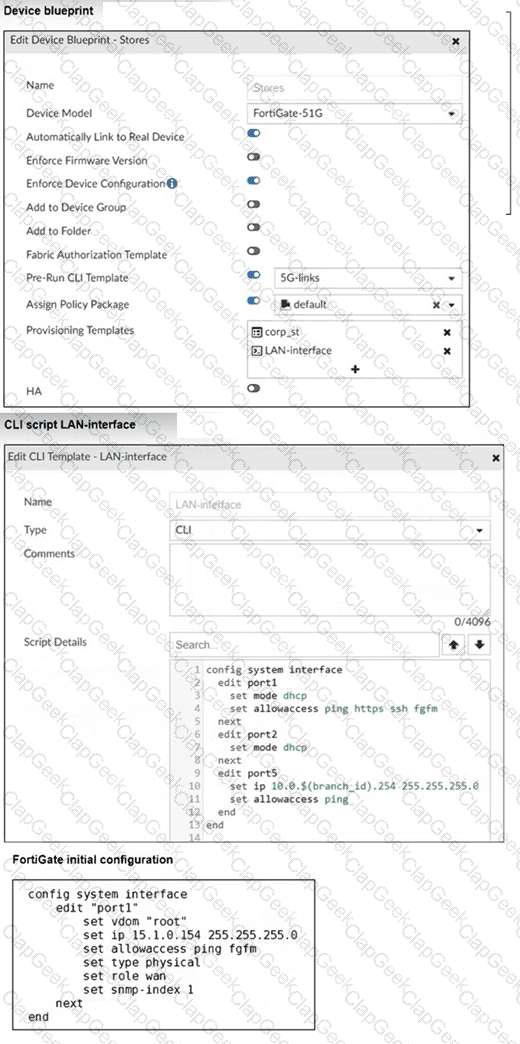
You manage an SD-WAN topology. You will soon deploy 50 new branches.

Which three tasks can you do in advance to simplify this deployment? (Choose three.)

Options:

A.

Update the DHCP server configuration.

B.

Create model devices.

C.

Create a ZTP template.

D.

Define metadata variables value for each device.

E.

Create policy blueprint.

Buy Now
Questions 24

An SD-WAN member is no longer used to steer SD-WAN traffic. The administrator updated the SD-WAN configuration and deleted the unused member. After the configuration update, users report that some destinations are unreachable. You confirm that the affected flow does not match an SD-WAN rule.

What could be a possible cause of the traffic interruption?

Options:

A.

FortiGate, with SD-WAN enabled, cannot route traffic through interfaces that are not SD-WAN members.

B.

FortiGate can remove some static routes associated with an interface when the member is removed from SD-WAN.

C.

FortiGate removes the layer 3 settings for interfaces that are removed from the SD-WAN configuration.

D.

FortiGate administratively brings down interfaces when they are removed from the SD-WAN configuration.

Buy Now
Questions 25

Which three factors about SLA targets and SD-WAN rules should you consider when configuring SD-WAN rules? (Choose three.)

Options:

A.

Member metrics are measured only if a rule uses the SLA target.

B.

SLA targets are used only by SD-WAN rules that are configured with a Lowest Cost (SLA) strategy.

C.

SD-WAN rules can use SLA targets to check whether the preferred members meet the SLA requirements.

D.

When configuring an SD-WAN rule, you can select multiple SLA targets if they are from the same performance SLA.

E.

When configuring an SD-WAN rule, you can select multiple SLA targets from different performance SLAs.

Buy Now
Questions 26

(You configure the overlay tunnels for an SD-WAN hub-and-spoke topology defined with IPsec tunnels, BGP on loopback, and dynamic BGP.

Which are two recommended IPsec settings for this topology? Choose two answers.)

Options:

A.

On the spoke, set the parameter net-device to enable.

B.

On the spoke, configure the parameter localid.

C.

On the hub, set the parameter mode-cfg to enable.

D.

On the hub, set the tunnel type to static.

Buy Now
Questions 27

(You want to configure two static routes: one that references an SD-WAN zone and a second one that references an SD-WAN member that belongs to that zone.

Which statement about this scenario is true? Choose one answer.)

Options:

A.

You cannot create static routes for individual SD-WAN members.

B.

You cannot create static routes that reference an SD-WAN zone.

C.

The destination subnets must be different.

D.

The source subnets must be different.

Buy Now
Questions 28

Refer to the exhibit that shows an SD-WAN zone configuration on the FortiManager GUI.

Based on the exhibit, how will the FortiGate device behave after it receives this configuration?

Options:

A.

The configuration instructs FortiGate to choose an ADVPN shortcut based on SD-WAN information.

B.

The configuration instructs FortiGate to allow ADVPN shortcuts for the tunnels of this SD-WAN zone.

C.

The configuration instructs FortiGate to establish shortcuts only when at least two members meet the SLA target.

D.

The configuration instructs FortiGate to establish shortcuts only for overlay interfaces that meet the SLA target HUB1_HC.

Buy Now
Exam Code: NSE6_SDW_AD-7.6
Exam Name: Fortinet NSE 6 - SD-WAN 7.6 Enterprise Administrator
Last Update: Jan 18, 2026
Questions: 95
NSE6_SDW_AD-7.6 pdf

NSE6_SDW_AD-7.6 PDF

$25.5  $84.99
NSE6_SDW_AD-7.6 Engine

NSE6_SDW_AD-7.6 Testing Engine

$30  $99.99
NSE6_SDW_AD-7.6 PDF + Engine

NSE6_SDW_AD-7.6 PDF + Testing Engine

$40.5  $134.99