clapgeek logo

You are working as an Enterprise Architect at a large company. The company runs many retail stores as well as an online marketplace that allows hundreds of brands to partner with the company. The company has a mature Enterprise Architecture (EA) practice and uses the TOGAF standard for its architecture development method. The EA practice is involved in all aspects of the business, with oversight provided by an Architecture Board with representatives from different parts of the business. The EA program is sponsored by the Chief Information Officer (CIO).
Many of the stores remain open all day and night. Each store uses a standard method to track sales and inventory, which involves sending accurate, timely sales data to a central AI-based inventory management system that can predict demand, adjust stock levels, and automate reordering. The central inventory management system is housed at the company’s central data center.
The company has acquired a major rival. The Chief Executive Officer (CEO) believes that the merger will enable growth through combined offerings and cost savings. The decision has been made to fully integrate the two organizations, including merging retail operations and systems. Duplicated systems will be replaced with one standard retail management system. The CIO expects significant savings from these changes across the newly merged company.
The rival company has successfully implemented the use of hand-held devices within stores for both customers and staff, which has increased satisfaction due to time savings. The CIO has approved the rollout of these devices to all stores but has stated that training should be brief, as there are many part-time employees.
You have been asked to confirm the most relevant architecture principles for this transformation. Based on the TOGAF Standard, which of the following is the best answer?
Scenario
Your role is that of an Enterprise Architect, reporting to the Chief Enterprise Architect, at a technology company.
The company uses the TOGAF standard as the method and guiding framework for its Enterprise Architecture (EA) practice. The Chief Technology Officer (CTO) is the sponsor of the activity. The EA practice uses an iterative approach for its architecture development. This has enabled the decision-makers to gain valuable insights into the different aspects of the business.
The nature of the business is such that the data and the information stored on the company systems is the company’s major asset and is highly confidential. The company employees travel a lot for work and need to communicate over public infrastructure. They use message encryption, secure internet connections using Virtual Private Networks (VPNs), and other standard security measures. The company has provided computer security awareness training for all its staff. However, despite good education and system security, there is still a need to rely on third-party suppliers for infrastructure and software.
The Chief Security Officer (CSO) has noted an increase in ransomware (malicious software used in ransom demands) attacks on companies with a similar profile. The CSO recognizes that no matter how much is spent on education and support, the company could be a victim of a significant attack that could completely lock them out of their important data.
A risk assessment has been completed, and the company has looked for cyber insurance that covers ransomware. The price for this insurance is very high. The CTO recently saw a survey that said 1 out of 4 businesses that paid ransoms could not get their data back, and almost thesame number were able to recover the data without paying. The CTO has decided not to get cyber insurance to cover ransom payment.
You have been asked to describe the steps you would take to strengthen the current architecture to improve data protection.
Based on the TOGAF standard, which of the following is the best answer?
Please read this scenario prior to answering the question
You are the Lead Enterprise Architect at a major agribusiness company. The company ' s main harvest is lentils, a highly valued food grown worldwide. The lentil parasite, broomrape, has been an increasing concern for many years and is now becoming resistant to chemical controls. In addition, changes in climate favor the propagation and growth of the parasite. As a result, the parasite cannot realistically be exterminated, and it has become pandemic, with lentil yields falling globally.
In response to the situation, the CEO has decided that the lentil fields will be used for another harvest. The company will also cease to process third-party lentils and will repurpose its processing plants. Thus, the target market will change, and the end-products will be different and more varied.
The company has recently established an Enterprise Architecture practice based on the TOGAF standard as method and guiding framework. The CIO is the sponsor of the activity. A formal request for architecture change has been approved. At this stage there is no fixed scope, shared vision, or objectives.
Refer to the scenario
You have been asked to propose the best approach for architecture development to realize the CEO ' s change in direction for the company.
Based on the TOGAF standard which of the following is the best answer?
You are working as an Enterprise Architect within the Enterprise Architecture (EA) team at a healthcare and life sciences company. The EA team is developing a secure system for researchers to share clinical trial information easily across the organization and with external partners.
Due to the highly sensitive nature of the information, each architecture domain must consider privacy and safety concerns. The healthcare division has been directed to minimize disruptions to clinical trials while introducing the new system gradually.
How would you identify the work packages for introducing the new system? Based on the TOGAF standard, which of the following is the best answer?
Full Scenario
You are employed as an Enterprise Architect working at a company that creates and sells products targeted at the end-user market. These products are sold worldwide through retail outlets.
You are part of the Enterprise Architecture (EA) team reporting to the EA team leader. The Enterprise Architecture practice at the company is sponsored by the Chief Technology Officer. The EA team has operated successfully for several years and has well developed processes based on the TOGAF standard. The EA team’s responsibilities include architecting product development processes and customer experience.
The company uses Agile product management techniques and Agile development practices. The EA team works with the product management teams, supporting and enabling the Agile development teams.
The company is in the middle of a digital transformation where it will extend its product range from physical products to also include digital products and digital services. This includes each of its product lines making the change to offer direct-to-consumer digital products and services associated with their existing physical products.
You are working with the EA team leader to develop a plan for the overall digital transformation project. You have been asked to work on a specific product line, which is experimenting with new direct-to-consumer digital products using a third-party platform. This project took a Minimum Viable Architecture approach, including a shallow architecture development iteration with a focus on the Application Architecture, followed by a quick and minimal implementation.
The initial feedback from customers shows low engagement and limited interest, suggesting that the new offerings may not align with customer needs. Looking at the data, it is clear that the products are not reaching the target audience that they were designed for, leading to a failure to meet the revenue target.
Question:
How will you gather information to address the low customer engagement and missed revenue target?
Based on the TOGAF standard which of the following is the best answer?
Please read this scenario prior to answering the question
You are employed as an Enterprise Architect within a large law firm. The firm operates in many countries and has a complicated structure. Every office must follow the local regulations in their country.
The firm has an established Enterprise Architecture (EA) department which has been operating for several years. It has architecture governance and development processes based on the TOGAF standard. In addition to the EA program, the firm has several management frameworks in use, including business planning, project/portfolio management, and operations management. The Architecture Board includes representatives from all parts of the firm.
The Chief Information Officer (CIO) is the sponsor of the Enterprise Architecture program. The CIO has actively encouraged architecting with agility within the EA department as her preferred approach for projects.
The CIO has given approval for a Request for Architecture Work to explore the adoption of an Al-based system for managing legal cases and financial processes.
Senior management has become more and more worried about how well the business is running, especially with the advancements in Artificial Intelligence (Al). Many of the firm ' s competitors have started using Al to assist with legal strategies, streamline processes, and boost productivity. One of the most important benefits Al has for the business is its ability to increase accuracy and minimize mistakes.
Some of the top managers are worried about a change in the way of working, and if it will achieve the goals.
Their staff also fear that management will use the system to measure their performance. The CIO wants to know how to address these concerns and reduce risks. The new system would provide guidance to legal professionals and analysts on which tasks to focus on. The main goals are to improve productivity and make better use of staff. In addition, the CIO hopes these changes will lead to higher customer satisfaction.
Refer to the scenario
The Chief Information Officer (CIO) has asked you how to address the concerns and lower risks when introducing artificial intelligence (Al) in the firm.
Based on the TOGAF standard which of the following is the best answer?
Please read this scenario prior to answering the question
You are working as the Chief Enterprise Architect within a law firm specializing in personal injury cases. Many of the firm ' s competitors have improved their litigation strategies, and efficiency by streamlining their processes using Artificial Intelligence {Al).
The CIO has approved a Request for Architecture Work to examine the use of Machine Learning in defining a new Al-driven litigation and finance process for the firm. This process would instruct the lawyers and analysts as to what tasks and portfolio they should work on. The key objectives are to increase task profitability, maximize staff utilization, and increase individual profitability.
The CIO has emphasized that the architecture should enable the fast implementation of continuous Machine Learning. The solution will need to be constantly measured for delivered value and be quickly iterated to success.
Some of the partners have expressed concerns about letting the Al make the decisions, others about the risks associated with use of it for the type of service they deliver. The CIO wants to know if these concerns can be addressed, and how risks will be covered by a new architecture enabling Al and Machine Learning.
Refer to the scenario
You have been asked to respond to the CIO recommending an approach that would enable the development of an architecture that addresses the concerns of the CIO and the concerns of the partners.
Based on the TOGAF standard which of the following is the best answer?
Scenario:
You are working as an Enterprise Architect at a large company. The company runs a chain of home improvement stores, as well as a website for selling products. The website lets many brands work with the company.
The stores open seven days a week and use a standard method to track sales and inventory. This involves sending accurate and timely sales data to a central inventory management system that can predict demand, adjust stock levels, and automate reordering. The website is supported by regional fulfillment centers and also uses the central inventory management system. The central inventory management system is housed at the company’s central data center.
The company has agreed to merge with a major competitor. The leadership teams of both organizations have said they are committed to a smooth transition for customers. All stores will keep their own brand names. They will combine the systems of the organizations, which includes merging retail operations and systems. Duplicated systems will be replaced with one standard retail management system. Additionally, they will reduce the number of applications being used. The CIO expects that these changes will lead to substantial cost savings for the newly merged company.
An enterprise plan for both organizations has been created. The aim is to set priorities for the transition, especially in terms of information management and application development. It is crucial to make decisions that will create long-term value.
The company has a mature Enterprise Architecture (EA) practice and uses the TOGAF standard for its architecture development method. The EA program is sponsored by the Chief Information Officer (CIO).
The Request for Architecture Work to oversee the transition has been approved. The project has been scoped, and you have been assigned to work on it.
You have been asked to confirm the most relevant architecture principles for the transition.
Based on the TOGAF Standard, which of the following is the best answer?
Please read this scenario prior to answering the question
You are employed as an Enterprise Architect for a company that supplies products for industrial production automation. You are part of an Enterprise Architecture (EA) team that has responsibilities across the company.
The company has multiple manufacturing plants where it assembles both standard and customized products. Each of these plants operates its own planning and production scheduling systems, as well as applications and control systems that drive the automated production line.
During a recent management meeting, the agenda included discussion of how a competitor company had improved production efficiency by replacing multiple planning and scheduling systems with a single cloud-based system. This had reduced lifecycle costs through reduced duplication, lowered software maintenance costs, and supported incremental replacement. The CIO claimed the company ' s current systems architecture is already optimized. However, as the competitor has reported better financial results, the CEO has requested an investigation of a cloud-based solution.
In response, the Architecture Board approved a Request for Architecture Work to find out if such an architecture transformation would lead to efficiency improvements. You have been asked to help the architecture team with this project.
A concern of the plant managers is the safety and dependability of using a remote centralized system for planning and scheduling production. The system they choose must also be able to work with the local partners in the supply chain at each plant.
The company has an Enterprise Architecture (EA) practice and uses the TOGAF standard as the basis for its work. It has been running for many years and has established governance and development processes for EA. The Chief Information Officer (CIO) sponsors the Enterprise Architecture program.
Refer to the scenario
You have been asked to describe how you will start the architecture project.
Based on the TOGAF standard, which of the following is the best answer?
Please read this scenario prior to answering the question
You are employed as an Enterprise Architect at a leading global technology enterprise
specializing in digital infrastructure, cloud computing, and data-centric innovation. The
company provides a vast ecosystem of platforms that serve billions of users across
the globe. These platforms span online marketplaces, advanced advertising networks,
Al-driven services, productivity tools, and digital entertainment experiences.
The senior leadership within the company is worried about the company ' s ability to
address all the opportunities around artificial intelligence (Al). They feel that the
business is at risk of falling behind its competitors, and that significant changes are
necessary for the business to remain competitive. Most senior leaders feel that the
operations need to be more efficient, and the organization needs to change to achieve
its future goals.
The company has an established Enterprise Architecture (EA) program based on the
TOGAF standard, sponsored jointly by the Chief Information Officer (CIO) and senior
executives. In your role as an Enterprise Architect within the EA team, you work
closely with the business stakeholders in the company as well as the sponsors.
The CEO has decided that reorganizing its subsidiaries around artificial intelligence
and machine learning will improve the way the company creates and delivers value.
The sponsors have approved a project for the reorganization which is being led by the
EA team.
The EA team have developed a strategic architecture which has been approved by
the sponsors. It includes an Architecture Vision, and high-level definitions of the
domain architectures. This sets out a plan over a multi-year period and covers three
distinct transformations to implement the reorganization.
The sponsors have read reports that the majority of transformation projects dealing
with digital and artificial intelligence are failing. They have made it clear that prior to
the approval of the detailed Implementation and Migration plan, the EA team needs to
address the risks associated with the reorganization. They want assurance that the
reorganization will succeed and deliver the promised increases in value for the
business.
Refer to the scenario
The EA team leader has asked how you would address the request from the
sponsors.
Based on the TOGAF standard, which of the following is the best answer?
Please read this scenario prior to answering the question
You are employed as an Enterprise Architect within a multinational company. The
company has been very successful and has been buying companies around the
world. This has led to a growing number of manufacturing divisions in various
locations with a complex supply chain.
The top management recently expressed concerns about the company ' s effectiveness
because of its multiple data centers and duplicate applications. The EA team has
been working on a project to solve this issue. An analysis shows that supply chain
issues have led to not enough products being produced to meet all the customer
demand.
A strategic architecture has been defined to help meet customer demand and manage
the supply chain more effectively. The strategic architecture involves combining
different Enterprise Resource Planning (ERP) applications that are currently used
separately in the company ' s production sites.
Each division has finished the Architecture Definition documentation to address their
own specific manufacturing needs. The Enterprise Architects have agreed an overall
strategy for the migration. They have defined a set of work packages that address the
gaps found. They have defined the intermediate architectural states between the
Baseline and Target architecture to add a new ERP environment into the company.
Because of the risks posed by this change from the current environment, the
architects have recommended that a phased approach should be taken to implement
the target architecture with several stages of change. They have created a draft
roadmap with the implementation process estimated to take over two years.
The company has an established Enterprise Architecture (EA) practice and follows the
TOGAF Architecture Development Method. The company also uses various
management frameworks such as business planning, project/portfolio management,
and operations management. The EA program is sponsored by the Chief Information
Officer (CIO). In your role as an Enterprise Architect within the EA team, you work
closely with the important stakeholders from the various divisions within the company.
Refer to the scenario
You have been assigned to plan the next steps for the migration. Which approach will
you choose?
Based on the TOGAF standard which of the following is the best answer?
Which of the following are two of the architecture domains that are considered as subsets of an overall Enterprise Architecture?
Full Question:
Which of the following statements about Architecture Partitioning are correct?
It is equivalent to architecture levels.
It enables different groups of architects to own and develop specific parts of an architecture.
It is implemented following a generally applicable partitioning model.
It is used to simplify the management of an Enterprise Architecture.
Exhibit
Consider the illustration showing an architecture development cycle Which description matches the phase of the ADM labeled as item 1?
Which of the following best describes the purpose of the Architecture Requirements Specification?
Consider the following statement.
According to the TOGAF standard, a governed approach of a particular deliverable will ensure adherence to the principles, standards, and requirements of the existing or developing architectures.
Which deliverable does this refer to?
Consider the description.
The typical contents of the assessment include: an overview of project progress and status and project architecture/design.
Which form of assessment is described?
Consider the following statements
1 A whole corporation or a division of a corporation
2 A government agency or a single government department
3 Partnerships and alliances of businesses working together such as a consortium or supply chain
What are those examples of according to the TOGAF Standard?
Consider the following statements:
The TOGAF ADM requires a partitioning model for architecture development
Architectures are partitioned when different teams need to work on different elements of the architecture at the same time
Partitions can be used to facilitate architecture re-use
Which statements about Architecture Partitioning are correct?
Which section of the TOGAF template for Architecture Principles should describe the relationship to other principles?
Consider the following descriptions of deliverables consumed and produced across the TOGAF ADM cycle.
General rules and guidelines, intended to be enduring and seldom amended, that inform and support the way in which an organization sets about fulfilling its mission
A set of quantitative statements that outline what an implementation project must do in order to comply with the architecture.
A document that is sent from the sponsoring organization to the architecture organization to trigger the start of an architecture development cycle
The scope and approach that will be used to complete an architecture development cycle
Complete the sentence. Deliverable 3 is the, deliverable 4 is a deliverable from
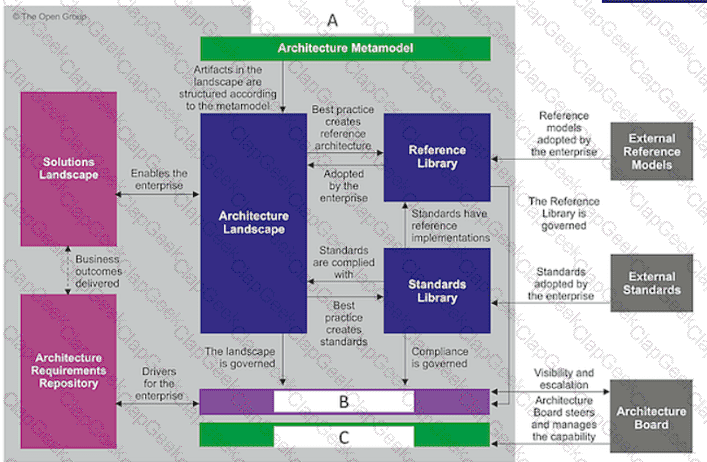
Full Question:
Complete the sentence. The assets in the B and C are structured from generic to specific to provide a consistent language to ____________.
When considering the scope of an architecture, what dimension considers to what level of detail the architecting effort should go?
What are the following activities part of?
. Risk classification
. Risk identification
. Initial risk assessment
Consider the following ADM phases objectives.
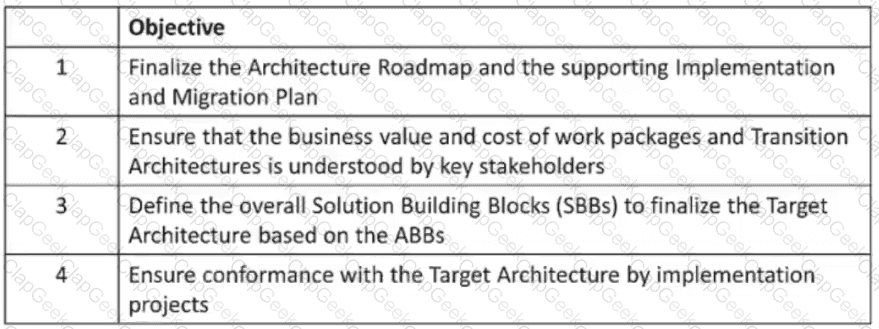
Which phase does each objective match?
Which of the following is the ability to develop use and sustain the architecture of a particular enterprise using architecture to govern change?
What is presented as ”striking a balance between positive and negative outcomes resulting from the realization of either opportunities or threats?
What structural framework does the TOGAF Standard define to support the management, leverage, and storage of architectural work products?
Exhibit
Consider the illustration showing an architecture development cycle Which description matches the phase of the ADM labeled as item 2?
Consider the following chart:
Which important concept for Enterprise Architecture Practitioners does it illustrate?
Full Scenario
You are employed as an Enterprise Architect in an Enterprise Architecture (EA) team at a food production and distribution company. The main goal of the company is to increase profit while meeting the needs of consumers for its products. Its customers want food that is produced sustainably, safely, and transparently, while reducing environmental impact.
The company has an Enterprise Architecture practice based on the TOGAF standard, using it as the method and guiding framework. The Chief Information Officer (CIO) is the sponsor of EA practice.
The business is a highly mechanized agricultural operation where business capabilities, including planting, harvesting, processing, packaging, and distribution, rely heavily on technology and machinery. The use of EA has enabled the decision makers to have valuable insights into the different aspects of the business.
The warmer climate has led to less successful farming, and the company is growing fewer crops than before. Also, prices for energy, feed, fuel, and fertilizer have gone up. This has caused a big drop in earnings. Due to the rising costs and lower profits, the company has been unable to do as much to help the environment. It especially has struggled to reduce its carbon emissions.
In response to the situation, the Chief Executive Officer (CEO) has decided that big changes are needed, that will lead both to improved crop production and profitability. They must look to all aspects of the business. This includes looking at the mix of crops to mitigate for the change in climate. The company will also cease to process its own crops and will sell off its processing facilities. Thus, the target market will change, and the end-products will be different and more varied. A formal request for architecture change has been approved. At this stage there is no fixed scope, shared vision, or objectives.
Question:
What is the best approach for architecture development to realize the CEO’s change in direction for the company?
Based on the TOGAF standard which of the following is the best answer?
Please read this scenario prior to answering the question
You are the Chief Enterprise Architect at a large food service company specializing in sales to trade and
wholesale, for example, restaurants and other food retailers.
One of your company ' s competitors has launched a revolutionary product range and is running a very
aggressive marketing campaign. Your company ' s resellers are successively announcing that they are not
interested in your company ' s products and will sell your competitor ' s.
The CEO has stated there must be significant change to address the situation. He has made it clear that
new markets must be found for the company ' s products, and that the business needs to pivot, and address the retail market as well as the existing wholesale market.
A consideration is the company ' s ability and willingness to change its business model, and if it is a temporary or permanent change. An additional risk factor is one of culture. The company has been used to a stable business with a reasonably well known and settled client base - all with its own local understandings and practices.
The CEO is the sponsor of the EA program within the company. You have been engaged with the sales,
logistics, production, and marketing teams, enabling the architecture activity to start. An Architecture Vision, Architecture Principles, and Requirements have all been agreed. As you move forward to develop a possible Target Architecture you have identified that some of the key stakeholders ' preferences are incompatible. The incompatibilities are focused primarily on time-to-market, cost savings, and the need to bring out a fully featured product range, but there are additional factors.
Refer to the scenario
You have been asked how you will address the incompatibilities between key stakeholder preferences.
Based on the TOGAF standard which of the following is the best answer?
Please read this scenario prior to answering the question
Your role is that of a consultant to the Lead Enterprise Architect in a multinational automotive manufacturer.
The company has a corporate strategy that focuses on electrification of its portfolio, and it has invested
heavily in a new shared car platform to use across all its brands. The company has four manufacturing
facilities, one in North America, two in Europe, and one in Asia.
A challenge that the company is facing is to scale up the number of vehicles coming off the production line to meet customer demand, while maintaining quality. There are significant supply chain shortages for electronic components, which are impacting production. In response to this the company has taken on new suppliers and has also taken design and production of the battery pack in-house.
The company has a mature Enterprise Architecture practice. The TOGAF standard is used for developing
the process and systems used to design, manufacture, and test the battery pack. The Chief Information
Officer and the Chief Operating Officer co-sponsor the Enterprise Architecture program.
As part of putting the new battery pack into production, adjustments to the assembly processes need to be made. A pilot project has been completed at a single location. The Chief Engineer, sponsor of the activity, and the Architecture Board have approved the plan for implementation and migration at each plant.
Draft Architecture Contracts have been developed that detail the work needed to implement and deploy the new processes for each location. The company mixes internal teams with a few third-party contractors at the locations. The Chief Engineer has expressed concern that the deployment will not be consistent and of acceptable quality.
Refer to the scenario
The Lead Enterprise Architect has asked you to review the draft Architecture Contracts and recommend the best approach to address the Chief Engineer ' s concern.
Based on the TOGAF Standard, which of the following is the best answer?
Please read this scenario prior to answering the question
You are employed as an Enterprise Architect at a technology company, reporting directly
to the Chief Enterprise Architect. The company supplies personnel and delivers cloud-
based solutions to numerous government agencies.
The nature of the business is such that the data and the information stored on the
company systems is the company ' s major asset and is highly confidential. The company
employees work remotely and need constant access to the company systems, which is
done by the public infrastructure. They use message encryption, secure internet
connections using Virtual Private Networks (VPNs), and other standard security
measures. The company provides computer security awareness training for all its staff.
The Chief Security Officer (CSO) has noted an increase in distributed denial of service
(DDoS) attacks on companies with a similar profile. The CSO understands that even
with thorough preparation, a major attack could stop employees from being able to do
their jobs. This could lead to a large financial loss, damage to the company ' s reputation
with customers, and employees being unable to work.
A risk assessment has been completed and the company has looked for cyber insurance
that covers such attacks. The price for this insurance is very high. The CTO has decided
not to get cyber insurance to cover such attacks.
The company follows the TOGAF standard as the method and guiding framework for its
Enterprise Architecture (EA) practice. The Chief Technology Officer (CTO) is the sponsor
of the activity. The practice uses an iterative approach for its architecture development.
This has enabled the decision makers to gain valuable insights into the different aspects
of the business
Please read this scenario prior to answering the question
You have been asked to describe the steps you would take to strengthen the current
architecture to improve data protection.
Based on the TOGAF standard which of the following is the best answer?
Please read this scenario prior to answering the question.
You are employed as an Enterprise Architect working within an Enterprise Architecture (EA) team at a car manufacturing company. Enterprise Architecture (EA) provides the company with a comprehensive framework to develop and manage their manufacturing infrastructure, processes for component production, and design and testing systems.
The company is moving ahead with switching to electric power for its vehicles. The shift from combustion engines to electric motors marks a fundamental transformation for the company. As a result, the company has invested heavily in a new standardized design, production efforts, and components to use across all its brands.
A challenge that the company is facing is to maintain quality while increasing the number of vehicles coming off the production line to meet customer demand. Significant supply chain shortages for some components are impacting production. In response to this the company has taken design and production of the battery pack in-house and contracted new suppliers.
You are working on a project to improve the manufacturing process and systems to design, produce, and test the battery pack. As part of putting the new battery pack into production, changes to the assembly processes need to be made. A successful trial has been completed at a single location. The Chief Engineer, sponsor of the project, and the Architecture Board have approved the plan to roll out these changes to each of the manufacturing plants.
The EA team leader has called a meeting. He notes that the Architecture Contract will serve as the key connection between architecture and implementation organizations. Preliminary Architecture Contracts are being developed to detail the work needed to put in place the new processes for each location. The company mixes internal teams with a few third-party contractors at the locations. The Chief Engineer is worried that the implementation and deployment will not be consistent and of satisfactory quality across all the locations.
The company uses the TOGAF standard as the foundation for its work, including the company’s internal Enterprise Architecture framework. Also, the company uses different management frameworks including business planning, project management, and operations management. The company has factories in North America, Europe, and Asia. The EA team is responsible for all the manufacturing plants.
Question:
The EA team leader has asked you for the best way to address the Chief Engineer’s concern.
Based on the TOGAF standard, which of the following is the best answer?
Scenario
You are working as an Enterprise Architect within an Enterprise Architecture (EA) team at a large government agency. The agency has multiple divisions.
The agency has a well-established EA practice and follows the TOGAF standard as its method for architecture development. Along with the EA program, the agency also uses various management frameworks, including business planning, project/portfolio management, and operations management. The EA program is sponsored by the Chief Information Officer (CIO), who has actively promoted architecting with agility within the EA department as her preferred approach for projects.
The government has mandated that the agency prepare themselves for an Artificial Intelligence (AI)-first world, which they have called their “AI-first” plan. As a result, the agency is looking to determine the impact and role that AI will play moving forward. The CIO has approved a Request for Architecture Work to look at how AI can be used for services across the agency. She has noted that digital platforms will be a priority for investment in order to scale the AI applications planned. Using AI to automate tasks and make things run smoother is seen as a big advantage. Process automation and improved efficiency from manual, repetitive activities have been identified as the key benefits of applying generative AI to their agency’s business. This will include back-office automation, for example, for help center agents who receive hundreds of email inquiries. This should also improve services for citizens by making them more efficient and personalized, tailored to each individual’s needs.
Many of the agency leaders are worried about relying too much on AI. Some leaders think their employees will need to learn new skills. Some employees are worried they might lose their jobs to AI. Other leaders worry about security and cyber resilience in the digital platforms needed for AI to be successful.
The leader of the Enterprise Architecture team has asked for your suggestions on how to address the concerns, and how to manage the risks of a new architecture for the AI-first project.
Based on the TOGAF standard, which of the following is the best answer?
You are working as an Enterprise Architect within an Enterprise Architecture (EA) team at a large government agency with multiple divisions. The agency has a well-established EA practice and follows the TOGAF standard as its method for architecture development. The government has mandated that the agency prepare for an " AI-first " world.
The agency wants to determine the impact and role of AI in its future services. The CIO has approved a Request for Architecture Work to explore the use of AI in services. Some leaders are concerned about reliance on AI, security, and employees’ need to acquire new skills.
The EA team leader seeks suggestions on managing the risks associated with a new architecture for the AI-first project. Based on the TOGAF standard, which of the following is the best answer?
Please read this scenario prior to answering the question
Your role is that of a senior architect, reporting to the Chief Enterprise Architect, at a medium-sized company with 400 employees. The nature of the business is such that the data and the information stored on the company systems is their major asset and is highly confidential.
The company employees travel extensively for work and must communicate over public infrastructure using message encryption, VPNs, and other standard safeguards. The company has invested in cybersecurity awareness training for all its staff. However, it is recognized that even with good education as well as system security, there is a dependency on third-parly suppliers of infrastructure and software.
The company uses the TOGAF standard as the method and guiding framework for its Enterprise Architecture (EA) practice. The CTO is the sponsor of the activity.
The Chief Security Officer (CSO) has noted an increase in ransomware (malicious software used in ransom demands) attacks on companies with a similar profile. The CSO recognizes that no matter how much is spent on education, and support, it is likely just a matter of time before the company suffers a significant attack that could completely lock them out of their information assets.
A risk assessment has been done and the company has sought cyber insurance that includes ransomware coverage. The quotation for this insurance is hugely expensive. The CTO has recently read a survey that stated that one in four organizations paying ransoms were still unable to recover their data, while nearly as many were able to recover the data without paying a ransom. The CTO has concluded that taking out cyber insurance in case they need to pay a ransom is not an option.
Refer to the scenario
You have been asked to describe the steps you would take to improve the resilience of the current architecture?
Based on the TOGAF standard which of the following is the best answer?
Please read this scenario prior to answering the question
You are employed as an Enterprise Architect at a multinational energy company. The company is committed to reducing its emissions. To achieve this, the company is increasing production of renewable energy and adopting eco-friendly practices.
The company has an Enterprise Architecture (RA) practice and follows the TOGAF standard for its EA framework. The EA team manages all the major projects in the company. The EA team reports to the Chief Technical Officer (CTO), who is the sponsor of the EA program. The Architecture Board is made up of senior leaders from all parts of the company.
The company is starting to invest in developing various kinds of renewable energy projects, including solar, and wind. A large part of the growth in its renewable energy portfolio has come from buying other companies. The company is keen on acquiring small startups and mid-size companies to leverage their technical innovations. This way, the company aims to outperform its competitors, scale rapidly, and establish a presence in new markets.
The existing business and the newly acquired companies are not working well together, which increasingly causes problems. In response, a strategic plan was created and approved. The plan aims to make the merged companies work more effectively together. This will save money by sharing their common assets, including fixed capital assets, research and development facilities, and resources.
The EA team have been asked to oversee the transformation to carry out the strategic plan. A Request for Architecture Work for the project has created and has been approved. The goal is to strengthen the company ' s position in the market and reduce costs by taking advantage of economies of scale. The Chief Executive Officer (CEO) has stated that to stay competitive and relevant, the company must transform or entirely reinvent its business model.
Refer to the Scenario
What needs to be done to make sure that the company succeeds with the changes and how should risks be managed?
Based on the TOGAF standard, which of the following is the best answer?
Full Scenario (Complete and Unmodified):
You are employed as an Enterprise Architect at a healthcare company. The company operates over 250 hospitals and is dedicated to transforming healthcare with new ideas and advancements. The company has multiple divisions including surgery centers, freestanding emergency departments, urgent care clinics, and physician practices. They also develop and supply a range of products and services, many with specialized systems and clinical needs.
The company ' s Enterprise Architecture (EA) department has been operating for several years and has mature, well-developed architecture governance and development processes following the TOGAF standard. The Chief Information Officer (CIO) is the sponsor of the Enterprise Architecture program.
Healthcare is a highly controlled sector, and the company must maintain robust security practices to keep patient information private and prevent data breaches. The company shares electronic health records with multiple providers and has standardized its medical coding for billing and reporting.
Many of the company’s rivals have begun using Artificial Intelligence (AI) in their operations, and the indications are that this will be transformative for healthcare delivery. This is something the EA department has been interested in for a while, and they had recently submitted an architecture Change Request which was approved. As a result, the CIO has approved a Request for Architecture Work to implement AI-based solutions in the company.
The project has been established and you have been assigned to work on it. Stakeholders, concerns, and business requirements have been identified. The stakeholders have made it clear that timely implementation of changes can be life-critical, and that changes should be focused on improving patient outcomes. They also have a concern about disruption due to the changes and require the systems to preserve clinical data access and maintain critical life-support systems during any outages.
The scope of what is inside and what is outside the architecture efforts has now been confirmed. Your task is to revisit and review the Architecture Principles, as they form part of the constraints on architecture work.
Question:
The EA team leader has asked you to explain which Architecture Principles are most relevant for this project.
Based on the TOGAF standard, which of the following is the best answer?
(Assume the company follows the example Architecture Principles from the TOGAF ADM Techniques – Architecture Principles chapter.)
Please read this scenario prior to answering the question
You have been appointed as Chief Enterprise Architect (CEA). reporting to the Chief Technical Officer (CTO), of a company established as a separate operating entity by a major automotive manufacturer. The mission of the company is to build a new industry leading unified technology and software platform for electric vehicles.
The company uses the TOGAF Standard as the basis for its Enterprise Architecture (EA) framework, and architecture development follows the purpose-based EA Capability model as described in the TOGAF Series Guide: A Practitioners ' Approach to Developing Enterprise Architecture Following the TOGAF® ADM.
An end-to-end Target Architecture has been completed with a roadmap for change over a five-year period. The new platform will be a cross-functional effort between hardware and software teams, with significant changes over the old platform. It is expected to be developed in several stages over three years. The EA team has inherited the architecture for the previous generation hardware and software automotive platform, some of which can be carried over to the new unified platform. The EA team has started to define the new platform, including defining which parts of the architecture to carry forward.
Enough of the Business Architecture has been defined, so that work can commence on the Information Systems and Technology Architectures. Those need to be defined to support the core business services that the company plans to provide. The core services will feature an innovative approach with swarm data generated by vehicles, paving the way for autonomous driving in the future.
The presentation and access to different variations of data that the company plans to offer through its platform pose an architecture challenge. The application portfolio and supporting infrastructure need to interact with various existing cloud services and data-
Refer to the scenario
You have been asked what approach should be taken to determine and organize the work to deliver the requested architectures?
Based on the TOGAF standard which of the following is the best answer?
Please read this scenario prior to answering the question
You are employed as an Enterprise Architect working at a vehicle manufacturing
company. The company specializes in buses and coaches. You are part of an
Enterprise Architecture (EA) team that has responsibilities across multiple divisions of
the company. EA provides the company with a comprehensive framework to develop
and manage their manufacturing infrastructure, processes for component production,
and design and testing systems.
The company has a corporate strategy that focuses on switching to electric power for
its vehicles. It has invested heavily in a new standardized design, production efforts,
and major components to use across all its product range. The company has multiple
manufacturing plants in North America, Europe, and in Asia.
Customer demand has caused a backlog of orders because many customers want to
have more environmentally friendly public transportation. There are not enough
electronic components available, which is making it hard to produce products and
meet customer demand. To address this issue, the company has started making the
battery packs themselves and has hired new suppliers.
The EA team is working on a project to improve the process and systems to design,
produce, and test the battery pack. As part of putting the new battery pack into
production, changes to the assembly processes need to be made. A trial has been
completed at a single location. The Chief Engineer, sponsor of the project, and the
Architecture Board have approved the plan to roll out these changes to all plants.
Preliminary Architecture Contracts are being developed to detail the work needed to
put in place the new processes for each location. The EA team leader has called a
meeting to discuss the contracts. It is emphasized that the Architecture Contract will
serve as the key connection between architecture and implementation organizations.
The company mixes internal teams with a few third-party contractors at the locations.
The Chief Engineer is worried that the implementation and deployment will not be
consistent and of satisfactory quality.
The company has an established EA practice. It uses the TOGAF standard as the
foundation for its work including the internal EA framework. Additionally, the company
uses various management frameworks such as business planning, project
management, and operations management.
Refer to the scenario
The EA team leader asks you how you would address the Chief Engineer ' s concern.
Based on the TOGAF standard, which of the following is the best answer?
Please read this scenario prior to answering the question
Your role is consultant to the Lead Architect within a multinational company that manufactures electronic components. The company has several manufacturing divisions located worldwide and a complex supply chain. After a recent study, senior management have stated a concern about business efficiency considering the company ' s multiple data centers and duplication of applications.
The company has a mature Enterprise Architecture (EA) practice and uses the TOGAF architecture development method in its EA practice. In addition to the EA program, the company has several management frameworks in use, including business planning, project/portfolio management, and operations management. The EA program is sponsored by the CIO.
A strategic architecture has been defined to improve the ability to meet customer demand and improve management of the supply chain. The strategic architecture includes the consolidation of multiple Enterprise Resource Planning (ERP) applications that have been operating independently in the divisions ' production facilities.
Each division has completed the Architecture Definition documentation to meet its own specific manufacturing requirements. The enterprise architects have defined a set of work packages that address the gaps identified. They have identified the value produced, effort required, and dependencies between work packages to reach a farget architecture that would integrate a new ERP environment into the company.
Because of the risks posed by change from the current environment, the architects have recommended that a phased approach occurs to implement the target architecture with several transition states. The overall implementation process is estimated to take several years.
Refer to the scenario
You have been asked what the next steps are for the migration planning.
Based on the TOGAF standard which of the following is the best answer?
Please read this scenario prior to answering the question
You have been appointed as senior architect working for an autonomous driving technology development company. The mission of the company is to build an industry leading unified technology and software platform to support connected cars and autonomous driving.
The company uses the TOGAF Standard as the basis for its Enterprise Architecture (EA) framework. Architecture development within the company follows the purpose-based EA Capability model as described in the TOGAF Series Guide: A Practitioners ' Approach to Developing Enterprise Architecture Following the TOGAF® ADM.
An architecture to support strategy has been completed defining a long-range Target Architecture with a roadmap spanning five years. This has identified the need for a portfolio of projects over the next two years. The portfolio includes development of travel assistance systems using swarm data from vehicles on the road.
The current phase of architecture development is focused on the Business Architecture which needs to support the core travel assistance services that the company plans to provide. The core services will manage and process the swarm data generated by vehicles, paving the way for autonomous driving in the future.
The presentation and access to different variations of data that the company plans to offer through its platform poses an architecture challenge. The application portfolio needs to interact securely with various third-party cloud services, and V2X (Vehicle-to-Everything) service providers in many countries to be able to manage the data at scale. The security of V2X is a key concern for the stakeholders. Regulators have stated that the user ' s privacy be always protected, for example, so that the drivers ' journey cannot be tracked or reconstructed by compiling data sent or received by the car.
Refer to the scenario
You have been asked to describe the risk and security considerations you would include in the current phase of the architecture development?
Based on the TOGAF standard which of the following is the best answer?
Please read this scenario prior to answering the question
Your role is that of a consultant to the Lead Enterprise Architect to an international supplier of
engineering services and automated manufacturing systems. It has three manufacturing plants
where it assembles both standard and customized products for industrial production
automation. Each of these plants has been operating its own planning and production
scheduling systems, as well as applications and control systems that drive the automated
production line.
The Enterprise Architecture department has been operating for several years and has mature,
well-developed architecture governance and development processes that are based on the
TOGAF Standard. The CIO sponsors the Enterprise Architecture.
During a recent management meeting, a senior Vice-President highlighted an interview where
a competitor company ' s CIO is reported as saying that their production efficiency had been
improved by replacing multiple planning and scheduling systems with a common Enterprise
Resource Planning (ERP) system located in a central data center. Some discussion followed,
with the CIO responding that the situations are not comparable, and the current architecture is
already optimized.
In response, the Architecture Board approved a Request for Architecture Work covering the
investigations to determine if such an architecture transformation would lead to improvements
in efficiency. You have been assigned to support the architecture team working on this project.
A well-known concern of the plant managers is about the security and reliability of driving their
planning and production scheduling from a remote centralized system. Any chosen system
would also need to support the current supply chain network consisting of local partners at
each of the plants.
Refer to the scenario
You have been asked to explain how you will initiate the architecture project.
Based on the TOGAF Standard, which of the following is the best answer?
Please read this scenario prior to answering the question.
You are employed as an Enterprise Architect at a healthcare company. The company operates over 250 hospitals and is dedicated to transforming healthcare with new ideas and advancements. The company has multiple divisions including surgery centers, freestanding emergency departments, urgent care clinics, and physician practices. They also develop and supply a range of products and services, many with specialized systems and clinical needs.
The company’s Enterprise Architecture (EA) department has been operating for several years and has mature, well-developed architecture governance and development processes following the TOGAF standard. The Chief Information Officer (CIO) is the sponsor of the Enterprise Architecture program.
Healthcare is a highly controlled sector, and the company must maintain robust security practices to keep patient information private and prevent data breaches. The company shares electronic health records with multiple providers and has standardized its medical coding for billing and reporting.
Many of the company’s rivals have begun using Artificial Intelligence (AI) in their operations, and the indications are that this will be transformative for healthcare delivery. This is something the EA department has been interested in for a while, and they had recently submitted an Architecture Change Request which was approved. As a result, the CIO has approved a Request for Architecture Work to implement AI-based solutions in the company.
The project has been established and you have been assigned to work on it. Stakeholders, concerns, and business requirements have been identified. The stakeholders have made it clear that timely implementation of changes can be life-critical, and that changes should be focused on improving patient outcomes. They also have a concern about disruption due to the changes and require the systems to preserve clinical data access and maintain critical life-support systems during any outages.
The scope of what is inside and what is outside the architecture efforts has now been confirmed. Your task is to revisit and review the Architecture Principles, as they form part of the constraints on architecture work.
Question:
The EA team leader has asked you to explain which Architecture Principles are most relevant for this project.
Based on the TOGAF standard, which of the following is the best answer?
(Note: You should assume the company follows the example set of Architecture Principles that are provided in the TOGAF standard, ADM Techniques, Architecture Principles chapter.)
Please read this scenario prior to answering the question
You are employed as an Enterprise Architect working within the Enterprise
Architecture (EA) team at an electric vehicle manufacturer. The company focuses on
designing, manufacturing, and advancing battery technology for sustainable
transportation, while also investing in charging infrastructure, autonomous driving
systems, and renewable energy integration.
The company is introducing a major change to its vehicle design over a five-year
period. This will be a cross-functional effort between hardware and software teams,
delivering significant new features in the vehicles they manufacture. It is planned to be
developed in phases. An architecture to support strategy has been completed with a
roadmap for a set of projects.
The EA team has taken over the architecture for the hardware and software
automotive platform used by current vehicles, some of which will be used again in the
new vehicle design. The EA team has started to pick which parts of the architecture to
use again.
The presentation and access to different variations of data that the company plans to
offer through its vehicles creates a design challenge. The application portfolio and
supporting infrastructure must connect with multiple cloud services and data
repositories in different countries to be able to handle the data at a large scale.
Enough of the Business Architecture has been defined, so that work can commence
on the Information Systems and Technology Architectures. Those architectures need
to be defined to support the primary business services that the company plans to
provide. These services will handle and use the data created by vehicles, preparing
the way for self-driving vehicles in the future.
The company uses the TOGAF standard as the basis for its Enterprise Architecture
framework. The EA team reports to the Chief Technical Officer (CTO), who is the
sponsor of the EA program. The CTO requires that the EA team follow the purpose-
based EA Capability model as described in the TOGAF Series Guide: A Practitioners '
Approach to Developing Enterprise Architecture Following the TOGAF® ADM.
Refer to the scenario
How would you plan, organize, and manage the architecture development at this
stage?
Based on the TOGAF standard which of the following is the best answer?




TESTED 05 Oct 2026