New Year Sale 70% Discount Offer - Ends in 0d 00h 00m 00s - Coupon code: clap70

MuleSoft-Platform-Architect-I Salesforce Certified MuleSoft Platform Architect (Mule-Arch-201) Questions and Answers

Questions 4

The implementation of a Process API must change.

What is a valid approach that minimizes the impact of this change on API clients?

Options:

A.

Update the RAML definition of the current Process API and notify API client developers by sending them links to the updated RAML definition

B.

Postpone changes until API consumers acknowledge they are ready to migrate to a new Process API or API version

C.

Implement required changes to the Process API implementation so that whenever possible, the Process API's RAML definition remains unchanged

D.

Implement the Process API changes in a new API implementation, and have the old API implementation return an HTTP status code 301 - Moved Permanently to inform API clients they should be calling the new API implementation

Buy Now
Questions 5

A company uses a hybrid Anypoint Platform deployment model that combines the EU control plane with customer-hosted Mule runtimes. After successfully testing a Mule API implementation in the Staging environment, the Mule API implementation is set with environment-specific properties and must be promoted to the Production environment. What is a way that MuleSoft recommends to configure the Mule API implementation and automate its promotion to the Production environment?

Options:

A.

Bundle properties files for each environment into the Mule API implementation's deployable archive, then promote the Mule API implementation to the Production environment using Anypoint CLI or the Anypoint Platform REST APIsB.

B.

Modify the Mule API implementation's properties in the API Manager Properties tab, then promote the Mule API implementation to the Production environment using API Manager

C.

Modify the Mule API implementation's properties in Anypoint Exchange, then promote the Mule API implementation to the Production environment using Runtime Manager

D.

Use an API policy to change properties in the Mule API implementation deployed to the Staging environment and another API policy to deploy the Mule API implementation to the Production environment

Buy Now
Questions 6

Which component monitors APIs and endpoints at scheduled intervals, receives reports about whether tests pass or fail, and displays statistics about API and endpoint

performance?

Options:

A.

API Analytics

B.

Anypoint Monitoring dashboards

C.

APT Functional Monitoring

D.

Anypoint Runtime Manager alerts

Buy Now
Questions 7

What condition requires using a CloudHub Dedicated Load Balancer?

Options:

A.

When cross-region load balancing is required between separate deployments of the same Mule application

B.

When custom DNS names are required for API implementations deployed to customer-hosted Mule runtimes

C.

When API invocations across multiple CloudHub workers must be load balanced

D.

When server-side load-balanced TLS mutual authentication is required between API implementations and API clients

Buy Now
Questions 8

An API is protected with a Client ID Enforcement policy and uses the default configuration. Access is requested for the client application to the API, and an approved

contract now exists between the client application and the API

How can a consumer of this API avoid a 401 error "Unauthorized or invalid client application credentials"?

Options:

A.

Send the obtained token as a header in every call

B.

Send the obtained: client_id and client_secret in the request body

C.

Send the obtained clent_id and clent_secret as URI parameters in every call

D.

Send the obtained clent_id and client_secret in the header of every API Request call

Buy Now
Questions 9

What CANNOT be effectively enforced using an API policy in Anypoint Platform?

Options:

A.

Guarding against Denial of Service attacks

B.

Maintaining tamper-proof credentials between APIs

C.

Logging HTTP requests and responses

D.

Backend system overloading

Buy Now
Questions 10

True or False. We should always make sure that the APIs being designed and developed are self-servable even if it needs more man-day effort and resources.

Options:

A.

FALSE

B.

TRUE

Buy Now
Questions 11

What is a typical result of using a fine-grained rather than a coarse-grained API deployment model to implement a given business process?

Options:

A.

A decrease in the number of connections within the application network supporting the business process

B.

A higher number of discoverable API-related assets in the application network

C.

A better response time for the end user as a result of the APIs being smaller in scope and complexity

D.

An overall tower usage of resources because each fine-grained API consumes less resources

Buy Now
Questions 12

A large lending company has developed an API to unlock data from a database server and web server. The API has been deployed to Anypoint Virtual Private Cloud

(VPC) on CloudHub 1.0.

The database server and web server are in the customer's secure network and are not accessible through the public internet. The database server is in the customer's AWS

VPC, whereas the web server is in the customer's on-premises corporate data center.

How can access be enabled for the API to connect with the database server and the web server?

Options:

A.

Set up VPC peering with AWS VPC and a VPN tunnel to the customer's on-premises corporate data center

B.

Set up VPC peering with AWS VPC and the customer's on-premises corporate data center

C.

Setup a transit gateway to the customer's on-premises corporate data center through AWS VPC

D.

Set up VPC peering with the customer's on-premises corporate data center and a VPN tunnel to AWS VPC

Buy Now
Questions 13

Which of the following sequence is correct?

Options:

A.

API Client implementes logic to call an API >> API Consumer requests access to API >> API Implementation routes the request to >> API

B.

API Consumer requests access to API >> API Client implementes logic to call an API >> API routes the request to >> API Implementation

C.

API Consumer implementes logic to call an API >> API Client requests access to API >> API Implementation routes the request to >> API

D.

API Client implementes logic to call an API >> API Consumer requests access to API >> API routes the request to >> API Implementation

Buy Now
Questions 14

An API implementation is being designed that must invoke an Order API, which is known to repeatedly experience downtime.

For this reason, a fallback API is to be called when the Order API is unavailable.

What approach to designing the invocation of the fallback API provides the best resilience?

Options:

A.

Search Anypoint Exchange for a suitable existing fallback API, and then implement invocations to this fallback API in addition to the Order API

B.

Create a separate entry for the Order API in API Manager, and then invoke this API as a fallback API if the primary Order API is unavailable

C.

Redirect client requests through an HTTP 307 Temporary Redirect status code to the fallback API whenever the Order API is unavailable

D.

Set an option in the HTTP Requester component that invokes the Order API to instead invoke a fallback API whenever an HTTP 4xx or 5xx response status code is returned from the Order API

Buy Now
Questions 15

What is true about API implementations when dealing with legal regulations that require all data processing to be performed within a certain jurisdiction (such as in the USA or the EU)?

Options:

A.

They must avoid using the Object Store as it depends on services deployed ONLY to the US East region

B.

They must use a Jurisdiction-local external messaging system such as Active MQ rather than Anypoint MQ

C.

They must te deployed to Anypoint Platform runtime planes that are managed by Anypoint Platform control planes, with both planes in the same Jurisdiction

D.

They must ensure ALL data is encrypted both in transit and at rest

Buy Now
Questions 16

A Mule 4 API has been deployed to CloudHub and a Basic Authentication - Simple policy has been applied to all API methods and resources. However, the API is still accessible

by clients without using authentication.

How is this possible?

Options:

A.

The APE Router component is pointing to the incorrect Exchange version of the APT

B.

The Autodiscovery element is not present, in the deployed Mule application

C.

No… for client applications have been created of this API

D.

One of the application’s CloudHub workers restarted

Buy Now
Questions 17

An API implementation is updated. When must the RAML definition of the API also be updated?

Options:

A.

When the API implementation changes the structure of the request or response messages

B.

When the API implementation changes from interacting with a legacy backend system deployed on-premises to a modern, cloud-based (SaaS) system

C.

When the API implementation is migrated from an older to a newer version of the Mule runtime

D.

When the API implementation is optimized to improve its average response time

Buy Now
Questions 18

An operations team is analyzing the effort needed to set up monitoring of their application network. They are looking at which API invocation metrics can be used to identify and predict trouble without having to write custom scripts or install additional analytics software or tools.

Which type of metrics can satisfy this goal of directly identifying and predicting failures?

Options:

A.

The number and types of API policy violations per day

B.

The effectiveness of the application network based on the level of reuse

C.

The number and types of past API invocations across the application network

D.

The ROI from each APT invocation

Buy Now
Questions 19

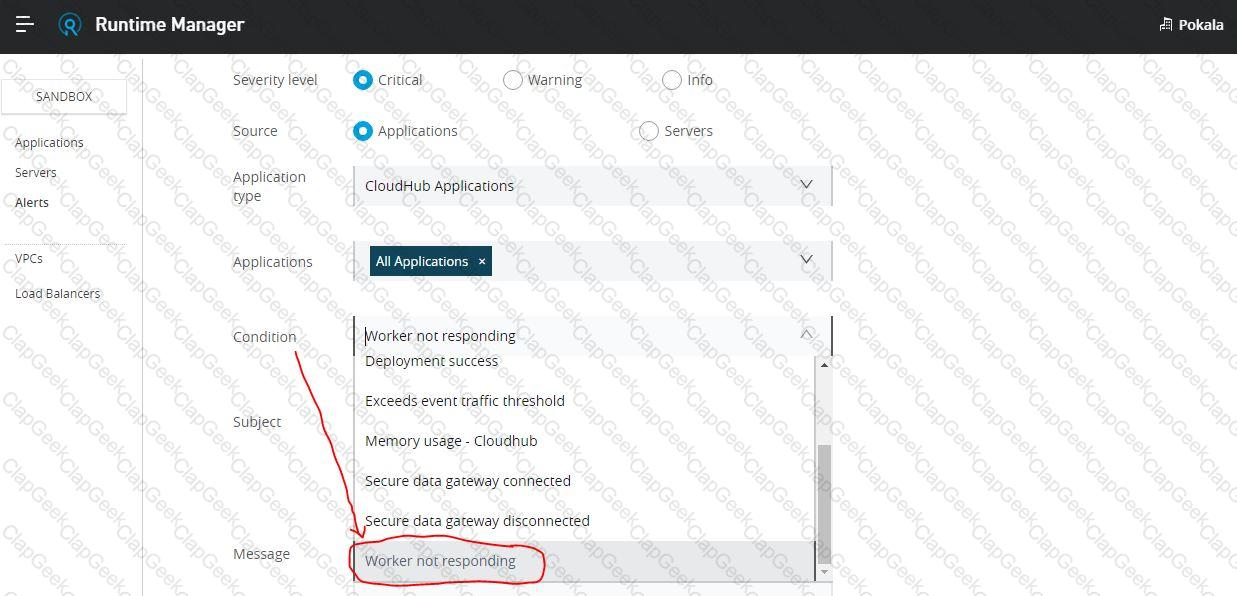
An API implementation is deployed on a single worker on CloudHub and invoked by external API clients (outside of CloudHub). How can an alert be set up that is guaranteed to trigger AS SOON AS that API implementation stops responding to API invocations?

Options:

A.

Implement a heartbeat/health check within the API and invoke it from outside the Anypoint Platform and alert when the heartbeat does not respond

B.

Configure a "worker not responding" alert in Anypoint Runtime Manager

C.

Handle API invocation exceptions within the calling API client and raise an alert from that API client when the API Is unavailable

D.

Create an alert for when the API receives no requests within a specified time period

Buy Now
Questions 20

An organization has implemented a Customer Address API to retrieve customer address information. This API has been deployed to multiple environments and has been configured to enforce client IDs everywhere.

A developer is writing a client application to allow a user to update their address. The developer has found the Customer Address API in Anypoint Exchange and wants to use it in their client application.

What step of gaining access to the API can be performed automatically by Anypoint Platform?

Options:

A.

Approve the client application request for the chosen SLA tier

B.

Request access to the appropriate API Instances deployed to multiple environments using the client application's credentials

C.

Modify the client application to call the API using the client application's credentials

D.

Create a new application in Anypoint Exchange for requesting access to the API

Buy Now
Questions 21

An organization is deploying their new implementation of the OrderStatus System API to multiple workers in CloudHub. This API fronts the organization's on-premises Order Management System, which is accessed by the API implementation over an IPsec tunnel.

What type of error typically does NOT result in a service outage of the OrderStatus System API?

Options:

A.

A CloudHub worker fails with an out-of-memory exception

B.

API Manager has an extended outage during the initial deployment of the API implementation

C.

The AWS region goes offline with a major network failure to the relevant AWS data centers

D.

The Order Management System is Inaccessible due to a network outage in the organization's on-premises data center

Buy Now
Questions 22

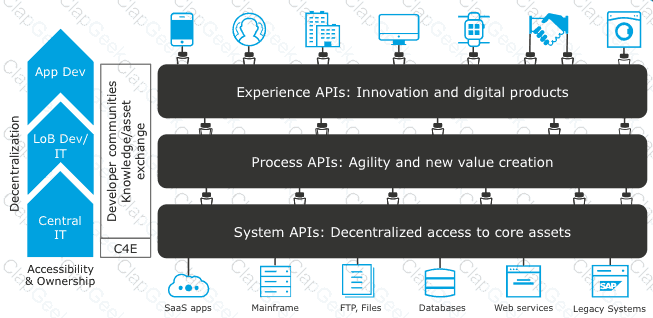
Which layer in the API-led connectivity focuses on unlocking key systems, legacy systems, data sources etc and exposes the functionality?

Options:

A.

Experience Layer

B.

Process Layer

C.

System Layer

Buy Now
Questions 23

When should idempotency be taken into account?

Options:

A.

When making requests to update currently locked entities

B.

When storing the results of s previous request for use in response to subsequent requests

C.

When sending concurrent update requests for the same entity

D.

When preventing duplicate processing from multiple sent requests

Buy Now
Questions 24

An enterprise is embarking on the API-led digital transformation journey, and the central IT team has started to define System APIs. Currently there is no Enterprise

Data Model being defined within the enterprise, and the definition of a clean Bounded Context Data Model requires too much effort.

According to MuleSoft's recommended guidelines, how should the System API data model be defined?

Options:

A.

If there are misspellings of the data fields in the back-end system, Systerm APIs should not correct it, and expose it as-is to mirror the back-end systems

B.

The data model of the System APIs should make use of data types that approximately mirror those from the back-end systems

C.

The data model should define its own naming convention, and not follow the same naming as the back-end systems

D.

The System APIs should expose all back-end system fields

Buy Now
Questions 25

Due to a limitation in the backend system, a system API can only handle up to 500 requests per second. What is the best type of API policy to apply to the system API to avoid overloading the backend system?

Options:

A.

Rate limiting

B.

HTTP caching

C.

Rate limiting - SLA based

D.

Spike control

Buy Now
Questions 26

A company requires Mule applications deployed to CloudHub to be isolated between non-production and production environments. This is so Mule applications deployed to non-production environments can only access backend systems running in their customer-hosted non-production environment, and so Mule applications deployed to production environments can only access backend systems running in their customer-hosted production environment. How does MuleSoft recommend modifying Mule applications, configuring environments, or changing infrastructure to support this type of per-environment isolation between Mule applications and backend systems?

Options:

A.

Modify properties of Mule applications deployed to the production Anypoint Platform environments to prevent access from non-production Mule applications

B.

Configure firewall rules in the infrastructure inside each customer-hosted environment so that only IP addresses from the corresponding Anypoint Platform environments are allowed to communicate with corresponding backend systems

C.

Create non-production and production environments in different Anypoint Platform business groups

D.

Create separate Anypoint VPCs for non-production and production environments, then configure connections to the backend systems in the corresponding customer-hosted environments

Buy Now
Questions 27

An API implementation is deployed to CloudHub.

What conditions can be alerted on using the default Anypoint Platform functionality, where the alert conditions depend on the API invocations to an API implementation?

Options:

A.

When the API invocations are sent directly to the internal DNS record of the API implementation

B.

When the API invocations are not over-a- secure TLS/SSL communication channel

C.

When the APL invecations originate from a geography different than the API

D.

When the number of API invocations are below a threshold

Buy Now
Questions 28

What is typically NOT a function of the APIs created within the framework called API-led connectivity?

Options:

A.

They provide an additional layer of resilience on top of the underlying backend system, thereby insulating clients from extended failure of these systems.

B.

They allow for innovation at the user Interface level by consuming the underlying assets without being aware of how data Is being extracted from backend systems.

C.

They reduce the dependency on the underlying backend systems by helping unlock data from backend systems In a reusable and consumable way.

D.

They can compose data from various sources and combine them with orchestration logic to create higher level value.

Buy Now
Questions 29

Which two statements are true about the technology architecture of an Anypoint Virtual Private Cloud (VPC)?

Choose 2 answers

Options:

A.

Ports 8081 and 8082 are used

B.

CIDR blacks are used

C.

Anypoint VPC is responsible for load balancing the applications

D.

Round-robin load balancing is used to distribute client requests across different applications

E.

By default, HTTP requests can be made from the public internet to workers at port 6091

Buy Now
Questions 30

A system API has a guaranteed SLA of 100 ms per request. The system API is deployed to a primary environment as well as to a disaster recovery (DR) environment, with different DNS names in each environment. An upstream process API invokes the system API and the main goal of this process API is to respond to client requests in the least possible time. In what order should the system APIs be invoked, and what changes should be made in order to speed up the response time for requests from the process API?

Options:

A.

In parallel, invoke the system API deployed to the primary environment and the system API deployed to the DR environment, and ONLY use the first response

B.

In parallel, invoke the system API deployed to the primary environment and the system API deployed to the DR environment using a scatter-gather configured with a timeout, and then merge the responses

C.

Invoke the system API deployed to the primary environment, and if it fails, invoke the system API deployed to the DR environment

D.

Invoke ONLY the system API deployed to the primary environment, and add timeout and retry logic to avoid intermittent failures

Buy Now
Questions 31

Select the correct Owner-Layer combinations from below options

Options:

A.

1. App Developers owns and focuses on Experience Layer APIs2. Central IT owns and focuses on Process Layer APIs3. LOB IT owns and focuses on System Layer APIs

B.

1. Central IT owns and focuses on Experience Layer APIs2. LOB IT owns and focuses on Process Layer APIs3. App Developers owns and focuses on System Layer APIs

C.

1. App Developers owns and focuses on Experience Layer APIs2. LOB IT owns and focuses on Process Layer APIs3. Central IT owns and focuses on System Layer APIs

Buy Now
Questions 32

When using CloudHub with the Shared Load Balancer, what is managed EXCLUSIVELY by the API implementation (the Mule application) and NOT by Anypoint Platform?

Options:

A.

The assignment of each HTTP request to a particular CloudHub worker

B.

The logging configuration that enables log entries to be visible in Runtime Manager

C.

The SSL certificates used by the API implementation to expose HTTPS endpoints

D.

The number of DNS entries allocated to the API implementation

Buy Now
Questions 33

An API has been updated in Anypoint exchange by its API producer from version 3.1.1 to 3.2.0 following accepted semantic versioning practices and the changes have been communicated via the APIs public portal. The API endpoint does NOT change in the new version. How should the developer of an API client respond to this change?

Options:

A.

The API producer should be requested to run the old version in parallel with the new one

B.

The API producer should be contacted to understand the change to existing functionality

C.

The API client code only needs to be changed if it needs to take advantage of the new features

D.

The API clients need to update the code on their side and need to do full regression

Buy Now
Questions 34

A Mule application exposes an HTTPS endpoint and is deployed to the CloudHub Shared Worker Cloud. All traffic to that Mule application must stay inside the AWS VPC.

To what TCP port do API invocations to that Mule application need to be sent?

Options:

A.

443

B.

8081

C.

8091

D.

8082

Buy Now
Questions 35

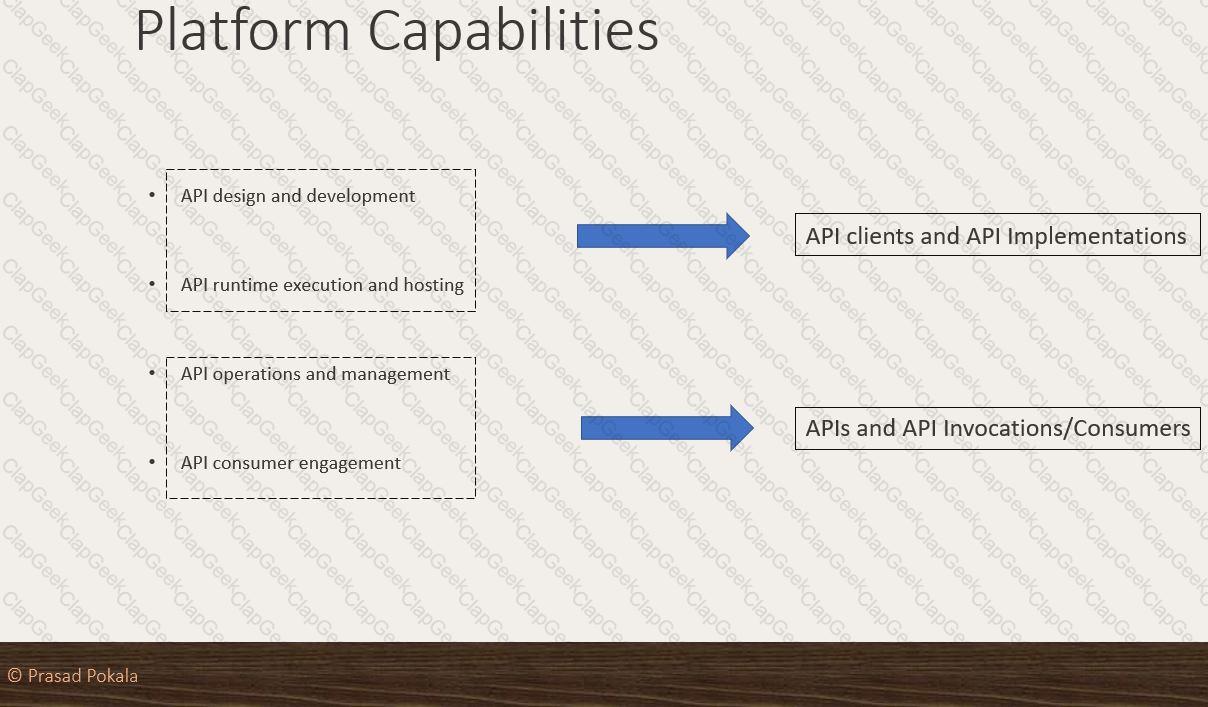
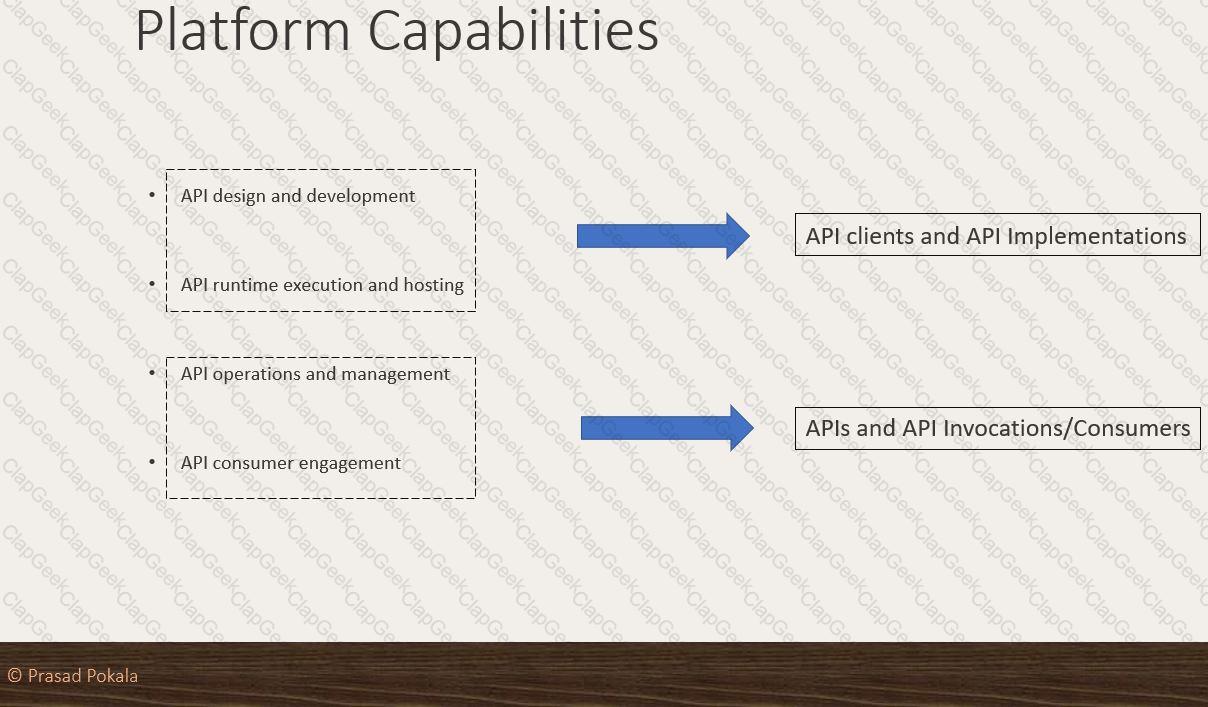
What Anypoint Platform Capabilities listed below fall under APIs and API Invocations/Consumers category? Select TWO.

Options:

A.

API Operations and Management

B.

API Runtime Execution and Hosting

C.

API Consumer Engagement

D.

API Design and Development

Buy Now
Questions 36

A TemperatureSensors API instance is defined in API Manager in the PROD environment of the CAR_FACTORY business group. An AcmelemperatureSensors Mule

application implements this API instance and is deployed from Runtime Manager to the PROD environment of the CAR_FACTORY business group. A policy that requires a valid

client ID and client secret is applied in API Manager to the API instance.

Where can an API consumer obtain a valid client ID and client secret to call the AcmeTemperatureSensors Mule application?

Options:

A.

In secrets manager, request access to the Shared Secret static username/password

B.

In API Manager, from the PROD environment of the CAR_FACTORY business group

C.

In access management, from the PROD environment of the CAR_FACTORY business group

D.

In Anypoint Exchange, from an API client application that has been approved for the TemperatureSensors API instance

Buy Now
Questions 37

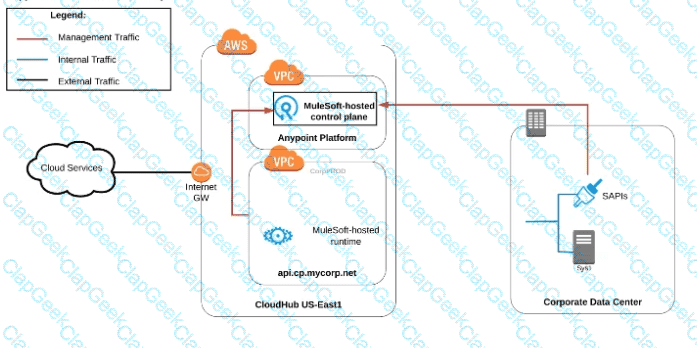
An organization uses various cloud-based SaaS systems and multiple on-premises systems. The on-premises systems are an important part of the organization's application network and can only be accessed from within the organization's intranet.

What is the best way to configure and use Anypoint Platform to support integrations with both the cloud-based SaaS systems and on-premises systems?

A) Use CloudHub-deployed Mule runtimes in an Anypoint VPC managed by Anypoint Platform Private Cloud Edition control plane

B) Use CloudHub-deployed Mule runtimes in the shared worker cloud managed by the MuleSoft-hosted Anypoint Platform control plane

C) Use an on-premises installation of Mule runtimes that are completely isolated with NO external network access, managed by the Anypoint Platform Private Cloud Edition control plane

D) Use a combination of Cloud Hub-deployed and manually provisioned on-premises Mule runtimes managed by the MuleSoft-hosted Anypoint Platform control plane
Options:

A.

Option A

B.

Option B

C.

Option C

D.

Option D

Buy Now
Questions 38

A customer has an ELA contract with MuleSoft. An API deployed to CloudHub is consistently experiencing performance issues. Based on the root cause analysis, it is

determined that autoscaling needs to be applied.

How can this be achieved?

Options:

A.

Configure a policy so that when the number of HTTP requests reaches a certain threshold the number of workers/replicas increases (horizontal scaling)

B.

Configure two separate policies: When CPU and memory reach certain threshold, increase the worker/replica type (vertical sealing) and the number of workers/replicas (horizontal sealing)

C.

Configure a policy based on CPU usage so that CloudHub auto-adjusts the number of workers/replicas (horizontal scaling)

D.

Configure a policy so that when the response time reaches a certain threshold the worker/replica type increases (vertical scaling)

Buy Now
Questions 39

An Order API must be designed that contains significant amounts of integration logic and involves the invocation of the Product API.

The power relationship between Order API and Product API is one of "Customer/Supplier", because the Product API is used heavily throughout the organization and is developed by a dedicated development team located in the office of the CTO.

What strategy should be used to deal with the API data model of the Product API within the Order API?

Options:

A.

Convince the development team of the Product API to adopt the API data model of the Order API such that the integration logic of the Order API can work with one consistent internal data model

B.

Work with the API data types of the Product API directly when implementing the integration logic of the Order API such that the Order API uses the same (unchanged) data types as the Product API

C.

Implement an anti-corruption layer in the Order API that transforms the Product API data model into internal data types of the Order API

D.

Start an organization-wide data modeling initiative that will result in an Enterprise Data Model that will then be used in both the Product API and the Order API

Buy Now
Questions 40

When must an API implementation be deployed to an Anypoint VPC?

Options:

A.

When the API Implementation must invoke publicly exposed services that are deployed outside of CloudHub in a customer- managed AWS instance

B.

When the API implementation must be accessible within a subnet of a restricted customer-hosted network that does not allow public access

C.

When the API implementation must be deployed to a production AWS VPC using the Mule Maven plugin

D.

When the API Implementation must write to a persistent Object Store

Buy Now
Questions 41

What API policy would be LEAST LIKELY used when designing an Experience API that is intended to work with a consumer mobile phone or tablet application?

Options:

A.

OAuth 2.0 access token enforcement

B.

Client ID enforcement

C.

JSON threat protection

D.

IPwhitellst

Buy Now
Questions 42

What Mule application can have API policies applied by

Anypoint Platform to the endpoint exposed by that Mule application?

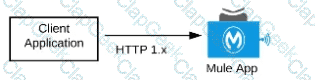
A) A Mule application that accepts requests over HTTP/1.x
B) A Mule application that accepts JSON requests over TCP but is NOT required to provide a response

C) A Mute application that accepts JSON requests over WebSocket

D) A Mule application that accepts gRPC requests over HTTP/2

Options:

A.

Option A

B.

Option B

C.

Option C

D.

Option D

Buy Now
Questions 43

To minimize operation costs, a customer wants to use a CloudHub 1.0 solution. The customer's requirements are:

* Separate resources with two Business groups

* High-availability (HA) for all APIs

* Route traffic via Dedicated load balancer (DLBs)

* Separate environments into production and non-production

Which solution meets the customer's needs?

Options:

A.

One production and one non-production Virtual Private Cloud (VPC). Use availability zones to differentiate between Business groups. Allocate maximum CIDR per VPCs to ensure HA across availability zones

B.

One production and one non-production Virtual Private Cloud (VPC) per Business group. Minimize CIDR aligning with projected application total. Choose a MuleSoft CloudHub 1.0 region with multiple availability zones. Deploy multiple workers for HA,

C.

One production and one non-production Virtual Private Cloud (VPC) per Business group. Minimize CIDR aligning with projected application total. Divide availability zones during deployment of APIs for HA.

D.

One production and one non-production Virtual Private Claud (VPC). Configure subnet to differentiate between business groups. Allocate maximum CIDR per VPCs to make it easier to add Child groups. Span VPC to cover three availability zones.

Buy Now
Questions 44

Which out-of-the-box key performance indicator measures the success of a typical Center for Enablement and is immediately available in responses from Anypoint Platform APIs?


Options:

A.

Per business group, the ratio of the number of production APT implementations deployed using a C1/CD pipeline to the number of production API implementations deployed manually

B.

Per deployed API implementation, the amount of bandwidth consumed each day

C.

Per published API, the number of developers that downloaded s version of the API specification

D.

Per published API, the number of consumers that requested access to the API and have been approved in the Production environment

Buy Now
Questions 45

What best explains the use of auto-discovery in API implementations?

Options:

A.

It makes API Manager aware of API implementations and hence enables it to enforce policies

B.

It enables Anypoint Studio to discover API definitions configured in Anypoint Platform

C.

It enables Anypoint Exchange to discover assets and makes them available for reuse

D.

It enables Anypoint Analytics to gain insight into the usage of APIs

Buy Now
Exam Name: Salesforce Certified MuleSoft Platform Architect (Mule-Arch-201)
Last Update: Jan 5, 2026
Questions: 152
MuleSoft-Platform-Architect-I pdf

MuleSoft-Platform-Architect-I PDF

$25.5  $84.99
MuleSoft-Platform-Architect-I Engine

MuleSoft-Platform-Architect-I Testing Engine

$30  $99.99
MuleSoft-Platform-Architect-I PDF + Engine

MuleSoft-Platform-Architect-I PDF + Testing Engine

$40.5  $134.99