clapgeek logo

A 30-year-old patient is injured in a motor vehicle collision. The patient cannot move their diaphragm, and they are apneic. In which of the following locations should the EMT suspect the spinal injury occurred?
A 12-year-old male suffered helmet-to-helmet contact while playing football. A bystander states, " He passed out for several seconds, then walked off the field under his own power. " He is now unresponsive, and his vital signs are BP 180/110, P 90, and R 6. You should suspect
A 21-year-old patient is nauseous and actively vomiting. The patient has a sweet odor on the breath. The skin is warm, flushed, and dry. The patient is breathing at 40/min. What should the EMT most strongly suspect is the cause of the patient ' s condition?
An EMT assists a 29-year-old patient with a metered-dose inhaler. After the patient inhales the medication, what should the EMT instruct the patient to do?
A choking patient becomes unresponsive. What should the EMT perform next? Select the two correct options.
A 23-year-old male is pacing and has incomprehensible speech. During your assessment, he throws a chair against the wall. You should next:
You have consulted with on-line medical direction to terminate resuscitation of a 74-year-old female. How should you inform her family of this decision?
Which of the following patient presentations at a mass casualty incident would indicate a red triage priority? Select the two answer options that are correct.
A 38-year-old patient is dyspneic and has facial swelling after eating at a restaurant. What should the EMT do first?
A 13-year-old patient is lethargic with a fever, headache, and a stiff neck. Which of the following statements should the EMT consider while caring for this patient? Select the two answer options that are correct.
Which of the following findings are indicative of increasing intracranial pressure? Select the two answer options that are correct.
While assisting an ALS unit, you observe a contaminated needle has been stuck into the mattress. You should
A law enforcement officer requests that you place the clothes from a sexual assault victim in a bag for transport to the hospital. Which type of bag should you use?
A 45-year-old patient has a persistent productive cough and difficulty breathing. Wheezing is noted upon auscultation. Should the EMT place an N95 mask or a surgical mask over the patient ' s nebulizer for additional protection, and why?
Which of the following signs or symptoms are indications of hypoglycemia? Select the three answer options that are correct.
In which of the following positions should a patient with an altered level of consciousness be transported?
What characteristics of the pediatric airway are different from the adult airway?
A 45-year-old male complains of a sudden onset of right flank pain that radiates to his right groin. He is pale, diaphoretic, and restless. You should suspect
A 9-year-old patient who was injured in an MCI is brought to the treatment area with a delayed triage tag. Which of the following signs or symptoms would the EMT expect to find? Select the three correct options.
A 65-year-old patient is unresponsive after falling from standing. Which of the following signs would be most indicative of increasing intracranial pressure? Select the three answer options that are correct.
You are transporting a febrile 62-year-old male who has a cough and body aches. His vital signs are BP 136/80, P 100, R 16, and his SpO₂ is 99% on room air. You should first:
A 77-year-old male presents with generalized aches and pain. He has been taking over-the-counter pain relief pills multiple times a day for the last 3 weeks. Your physical examination is most likely to reveal signs of
A 56-year-old female with diabetes reports dizziness, shortness of breath, and weakness that began an hour ago. The EMT should suspect
A patient is having a stroke. Which of the following details are most important to report to the receiving hospital? Select the two answer options that are correct.
The EMT is first on scene at a motor vehicle collision. How should the EMT park the ambulance?
An EMT is using a BVM to ventilate a 28-year-old patient with asthma. The patient is unresponsive, and their vital signs are BP 70/40, P 142, R 8, and SpO2 89% on room air. The patient is becoming increasingly difficult to ventilate. What should the EMT do next?
Witnesses state a patient is unresponsive and not breathing after a vehicle collision. What action should the EMT perform first?
Which of the following would potentially complicate patient care during a helicopter transport?
What components are necessary to maintain adequate perfusion? Select the three correct options.
A 45-year-old patient has chest pain, shortness of breath, and skin that is cool and diaphoretic. The patient states they have a feeling of impending doom. Which of the following conditions should the EMT most strongly suspect?
A 20-year-old patient has shortness of breath and audible wheezes that began suddenly. Urticaria is present. The vital signs are BP 82/48, P 104, R 24, and SpO₂ 91% on room air. Which of the following interventions should the EMT perform next?
A 45-year-old male is lying unresponsive on the floor. He is cyanotic with shallow respirations. After opening his airway, you should
A 60-year-old patient has severe pain in the right hip after falling down four stairs. They have deformity and shortening of the right leg. The vital signs are BP 164/88, P 90, R 18, and SpO₂ 96% on room air. What actions should the EMT take for this patient? Select the two answer options that are correct.
An 84-year-old patient has a sudden onset of weakness to one side of the body. The patient has a history of hypertension and high cholesterol. The vital signs are BP 176/94 mmHg, P 108/min, R 18/min, and SpO₂ 97% on room air. For which of the following additional symptoms should the EMT assess? Select the three correct options.
A 48-year-old patient has fever and bloody stools. The vital signs are BP 92/60 mmHg, P 118/min, R 20/min, and SpO₂ 92% on room air. What additional finding most strongly indicates bowel perforation as the cause of the patient ' s presentation?
An unresponsive 14-year-old presents with agonal respirations and pinpoint pupils. You should suspect he has ingested
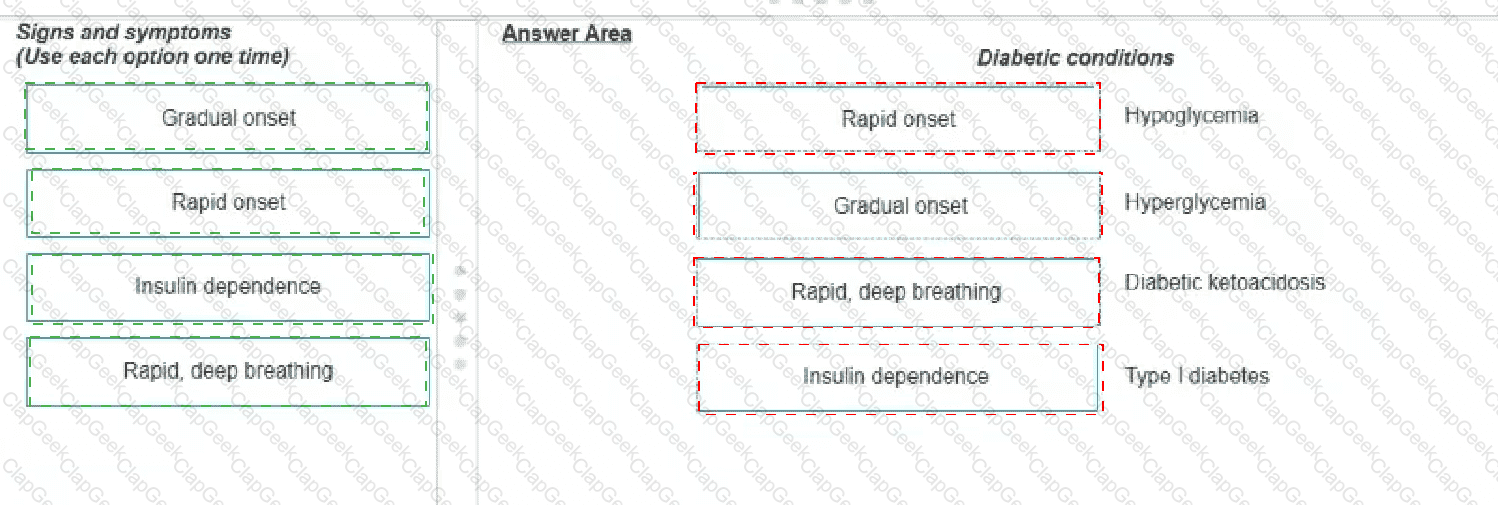
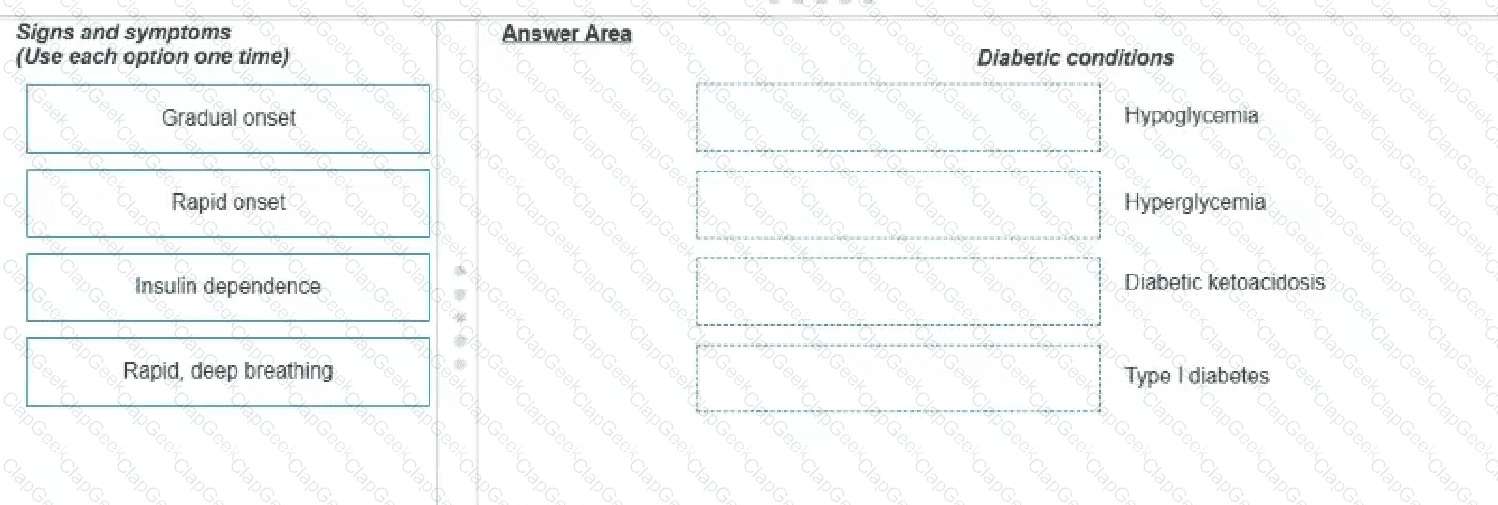
Which of the following signs or symptoms would be most closely associated with each of these diabetic conditions? Move each sign or symptom into the Answer Area one time to indicate the most closely associated diabetic condition.
A 69-year-old patient has worsening respiratory symptoms secondary to congestive heart failure. Which of the following actions are proper techniques for auscultating the patient ' s lung sounds? Select the three answer options that are correct.
A 40-year-old patient is unresponsive following an electrical injury. What is the most likely cause of the patient ' s mental status?
Which of the following sections are designated by command at an MCI? Select the three correct options.
A 52-year-old patient is in cardiac arrest. During CPR, the patient begins to groan. There is a strong carotid pulse at a rate of 67. Which of the following actions should the EMT perform next?
A 7-year-old patient has severe difficulty breathing. Which of the following characteristics indicate that the patient is in respiratory failure? Select the two answer options that are correct.
A 67-year-old patient is unresponsive, and an EMT checks for a pulse prior to applying an AED. Which of the following screenable rhythms, ventricular fibrillation or ventricular tachycardia, if either, may still produce a pulse in this patient?
A 25-year-old patient had ingested an unknown quantity of a household cleaner one hour earlier. The patient has swelling around the mouth and stridor. Which of the following actions should the EMT prioritize? Select the two answer options that are correct.
A 50-year-old male became disoriented while playing basketball. His skin is hot and red. You should suspect
You observe your partner as he completes a patient care report. He documents giving a medication that you know he did not administer. You should first
A 37-year-old female presents with increased work of breathing after blunt chest trauma. During transport, her SpO₂ is 92% and decreasing. You auscultate clear lung sounds. The most likely cause of her condition is
The EMT is experiencing a fight-or-flight response after taking a patient emergently to the hospital. Which response stage of the general adaptation syndrome is the EMT experiencing?
Which of the following actions are steps for inserting a nasopharyngeal airway? Select the two answer options that are correct.
A 4-year-old female has trouble breathing. Her respiratory rate is 40 and you hear grunting. She has a weak pulse and only responds to painful stimuli. You should suspect:
What is the difference between the injury patterns in children and those of adults?
An 83-year-old patient is unresponsive and lying on the floor. The patient has a large bruise and laceration on the forehead. The patient’s vital signs are BP 90/60 mmHg, P 126/min, and R 0. Which of the following conditions should the EMT most suspect?
A 27-year-old patient reports trouble breathing after being struck by a car. Which of the following findings are indicative of a possible chest wall injury? Select the three answer options that are correct.
A 31-year-old patient has an open femur fracture and an unstable pelvis after falling 15 feet. They are conscious and responsive to verbal stimuli. The vital signs are BP 86/42, P 136, R 24, and SpO₂ 92% on room air. The patient has which of the following types of shock? Select the two correct options.
An 80-year-old female who has diabetes complains of generalized weakness, nausea, vomiting, and fatigue that began 1 hour ago. She has equal hand grasp and her face is symmetrical. Her blood glucose level is 130 mg/dL. What is the most likely cause of her symptoms?
A 19-year-old patient has received multiple stab wounds. The patient is unresponsive. The vital signs are BP 82/60, P 116, R 28, and SpO2 86%. Which substance would the EMT expect to increase in the patient ' s body?
A 3-year-old female choked while eating a hot dog and then became unresponsive. You should first
An EMT is on the scene of a possible terrorist attack. A victim has excessive oral secretions, is urine and bowel incontinent, and begins to vomit. What should the EMT administer?
A 43-year-old patient is experiencing a sudden onset of coughing, nausea, and shortness of breath. The patient has a history of alcohol use disorder and major depressive disorder. The patient spent the day cleaning. The kitchen has food in various forms of decay. The patient ' s condition improves slightly once oxygen has been administered. Which of the following environmental factors is the most likely cause of the patient ' s presentation?
An EMT has been assigned as the treatment supervisor at a mass casualty incident. Which of the following actions should the EMT perform?
A 78-year-old female tripped and fell while walking. Her left leg is rotated externally and shorter than her right leg. You should suspect
A 50-year-old patient has shortness of breath and chest pain that worsens with inspiration. The skin is hot and dry. The patient also has a non-productive cough, and coarse crackles are heard upon auscultation on the right side. What condition is most likely causing this patient’s signs and symptoms?
A 58-year-old male claims that he is going to kill himself. He tells you that he is living alone and has just lost his job. He has no other means of support and sees no purpose in living. Which of the following statements about this patient is correct?
A 23-year-old patient reports loss of appetite, vomiting, fatigue, and joint pain. The patient has yellow sclera and right upper quadrant pain. Which of the following conditions is most likely the cause of the signs and symptoms?
A 3-year-old patient ingested laundry detergent. The patient is drowsy and has crackles in all lung fields. What should most concern the EMT at this time? Select the three answer options that are correct.
Which of the following techniques are appropriate for examining a patient with an acute abdomen? Select the two correct options.




TESTED 17 Oct 2026