clapgeek logo

You wrote this test against your fct_orders model to confirm status filters were properly applied by a parent model:
{{
config(
enabled=true,
severity='error'
)
}}
select *
from {{ ref('fct_orders') }}
where status_code = 13
Which statement about this test is true?
16. Your tests folder looks like:
tests
└── generic
└── furniture_customers_test.sql
macro_stg_tpch_orders_assert_pos_price.sql
macro_stg_tpch_suppliers_assert_pos_acct_bal.sql
stg_tpch_orders_assert_positive_price.sql
You run the command:
dbt test --select 'test_type:singular'
What will the command run?
Options from screenshot:
A developer has updated multiple models in their dbt project, materialized as tables and views.
They want to run and test all models upstream and downstream from the modified models that are materialized as views.
What command will achieve this? Choose 1 option.
A developer imports a package from a private repository called timeformat for use within their project.
Which statement is correct? Choose 1 option.
Options:
Examine this query:
select *
from {{ ref('stg_orders') }}
where amount_usd < 0
You want to make this a generic test across multiple models.
Which set of two standard arguments should be used to replace {{ ref('stg_orders') }} and amount_usd? Choose 1 option.
You work at an e-commerce company and a vendor provides their inventory data via CSV file uploads to an S3 bucket.
How do you prep the data for dbt transformations?
Choose 1 option.
28. Consider this DAG:
model_a → model_c → model_e
model_b → model_d → model_f
(With model_c and model_d both feeding into the final layer.)
You execute:
dbt run --fail-fast
in production with 2 threads. During the run, model_b and model_c are running in parallel when model_b returns an error.
Assume there are no other errors in the model files, and model_c was still running when model_b failed.
Which model or models will successfully build as part of this dbt run? Choose 1 option.
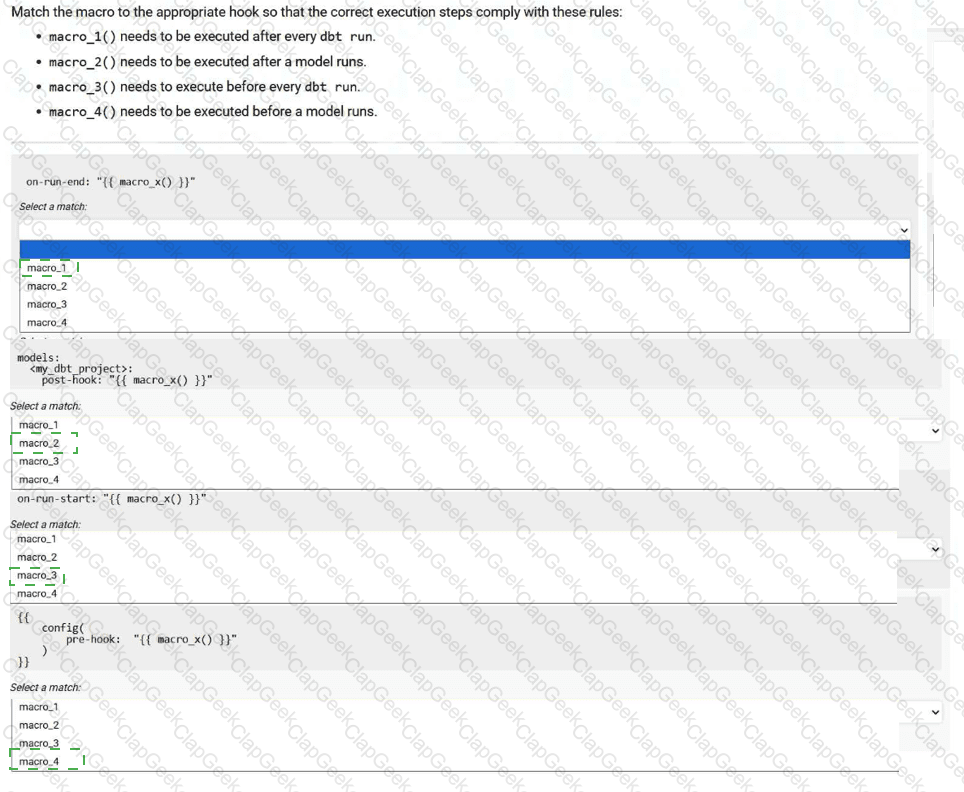
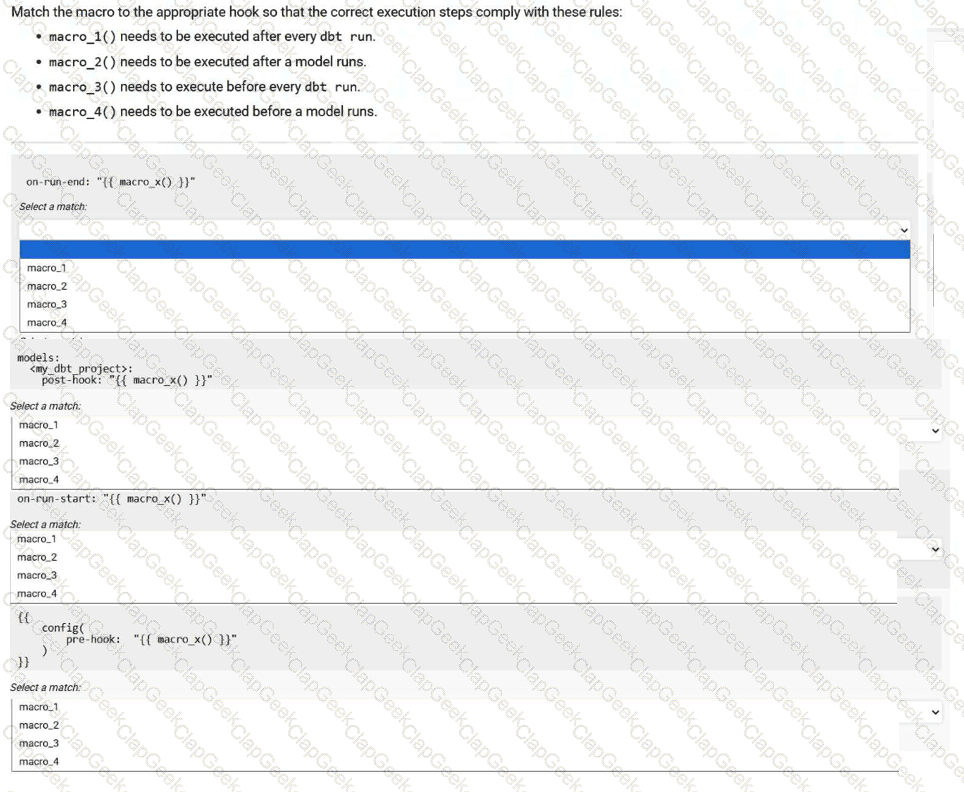
Match the macro to the appropriate hook so that the correct execution steps comply with these rules:
macro_1() needs to be executed after every dbt run.
macro_2() needs to be executed after a model runs.
macro_3() needs to execute before every dbt run.
macro_4() needs to be executed before a model runs.
Given this dbt_project.yml:
name: "jaffle_shop"
version: "1.0.0"
config-version: 2
profile: "snowflake"
model-paths: ["models"]
macro-paths: ["macros"]
snapshot-paths: ["snapshots"]
target-path: "target"
clean-targets:
- "logs"
- "target"
- "dbt_modules"
- "dbt_packages"
models:
jaffle_shop:
orders:
materialized: table
When executing a dbt run your models build as views instead of tables:
19:36:14 Found 1 model, 0 tests, 0 snapshots, 0 analyses, 179 macros, 0 operations, 0 seed files, 0 sources, 0 exposures, 0 metrics
19:36:16 Concurrency: 1 threads (target='default')
19:36:17 Finished running 1 view model in 3.35s.
19:36:17 Completed successfully
19:36:17 Done. PASS=1 WARN=0 ERROR=0 SKIP=0 TOTAL=1
Which could be a root cause of why the model was not materialized as a table?
The target-path is incorrectly configured.




TESTED 19 Sep 2026