clapgeek logo

A customer is upgrading its data-center structured cabling to SMF. At the same time, the customer wants to upgrade the spine switches in its spine-and-leaf topology. A key objective of this upgrade is to eventually support 400GbE leaf-to-spine links. However, for some time, many leaf switches will continue to support 100GbE uplinks.
What is a valid recommendation for the spine switches?
Waratah Hospital, located in Australia, plans to relocate many data-center services to a new facility. (The remaining legacy data center is not included in this project.) Waratah Hospital has engaged an external consultant to help design the new data-center network.
Based on the data-center network-infrastructure requirements, the external consultant has produced a high-level design. The design document is summarized below.
Requirements and information:
Six racks in the data-center room (a single row).
Redundant top-of-rack leaf switches with back-to-front cooling in every rack, delivering 10/25-Gbps connectivity to servers, storage, and other devices.
Four 100-GbE uplinks per leaf switch.
The customer requested that all switch ports face the rear of the rack racks (hot aisle).
OOB management for servers, storage, and network devices must be provided through an external switch with back-to-front cooling. This switch must be included in the solution. One OOB switch provides connectivity for two racks.
Core equipment for the OOBM network is being reused.
Middle-of-row spine switches.
The data center must connect to the hospital building through links providing 400 Gbps.
Internet access is supplied through an existing firewall cluster containing two firewalls, with one firewall in each data room. The second firewall operates in standby mode, and VRRP is used for firewall failover. The data-center network must connect to these firewalls through links totaling 100 Gbps.
The external link is a dark-fiber direct link using single-mode fiber (OS2). The distance to the main hospital is 1.5 KM. The links will terminate on two core switches in the hospital.
The customer additionally requires:
99.999% uptime for this life-critical environment.
Planned and unplanned downtime must be minimized.
Software upgrades are permitted only once per year, with close to zero downtime.
All life-critical resources are accessed locally, and all resources reside within the hospital campus.
Waratah Hospital requires a highly secure data-center environment. Encrypted wire-speed connectivity between the data room and hospital is mandatory because the inter-building link crosses a public road.
Waratah Hospital has a mixture of virtualized (vSphere) servers, Nutanix storage, bare-metal servers, backup servers, and other devices.
Previously, the hospital experienced a security breach that caused data loss, network downtime, and identity theft.
Refer to the scenario. You have learned that the customer must extend two VRFs between the new data-center facility and the hospital. To meet the scenario requirements and general best practices, what should you recommend to connect border leaf switches to the hospital core?
You have designed a two-tier L2 data center network for a customer. While presenting the solution, the customer states that they have a mission-critical multicast application with sources and receivers in the data center.
Which CX feature, in addition to features supplied by the PIM-SM standard, should you explain to emphasize the value of your solution?
You are completing a proposal for a data center network that includes 14 CX 8325 switches, 6 CX 6300M switches, and Fabric Composer licenses for these switches.
What is one assumption that could be included in the assumptions documentation?
Waratah Hospital, located in Australia, plans to move many data center services to a new facility. (The remaining legacy data center is not included in this project.) Waratah Hospital engaged an external consultant to help with the new data center network design.
Based on the data center network-infrastructure requirements, the external consultant has produced a high-level design. The following summarizes the design document’s contents.
Requirements and information:
Six racks in the data center room (a single row).
Redundant Top of Rack leaf switches with back-to-front cooling in every rack, delivering 10/25 Gbps connectivity to servers, storage, and other devices.
Four 100 GbE uplinks per leaf switch.
The customer requested that all switch ports face the back of the racks (hot aisle).
OOB management for servers, storage, and network must be delivered through an external switch with back-to-front cooling. This switch must be included in the solution. One OOB switch provides connectivity for two racks.
Core equipment for the OOBM network is being reused.
Middle-of-row spine switches.
The data center must connect to the hospital building with links providing 400 Gbps.
Internet access is provided through an existing firewall cluster with two firewalls, with each firewall in one data room. The second firewall operates in standby mode, and VRRP is used on the firewalls for failover. The data center network must connect to these firewalls with links totaling 100 Gbps.
The external link is a dark-fiber direct link based on single-mode fiber (OS2). The distance to the main hospital is 1.5 KM. The links will terminate on two core switches in the hospital.
The customer also requires:
99.999% uptime for this life-critical environment.
Planned and unplanned downtime must be minimized.
Software upgrades are permitted only once per year with close to zero downtime.
All life-critical resources are accessed locally, and all resources are within the hospital campus.
Waratah Hospital requires a highly secure data-center environment. Encrypted wire-speed connectivity between the data room and the hospital is mandatory because the link between the buildings crosses a public road.
Waratah Hospital has a mix of virtualized (vSphere) servers, Nutanix storage, bare-metal servers, backup servers, and other devices.
In the past, the hospital experienced a security breach that caused data loss, network downtime, and identity theft.
Refer to the scenario. You have learned that the customer must extend two VRFs between the new data center network and the firewall. To meet the scenario requirements and general best practices, what should you recommend for connecting border leaf switches to the hospital core?
A long-standing customer has acquired a company with 3,500 employees and plans to bring the new data center sites up to its standards. The customer has requested a bill of materials based only on the locations and port counts at the data center sites.
Which valid assumptions should be documented in the proposal? Choose two.
A customer operates a highly virtualized data center for which you are designing a two-tier Layer 2 data center.
What are the characteristics of a design that extends VLANs only to the ToR switches and server ports that strictly require those VLANs? Choose two.
Refer to the exhibit.
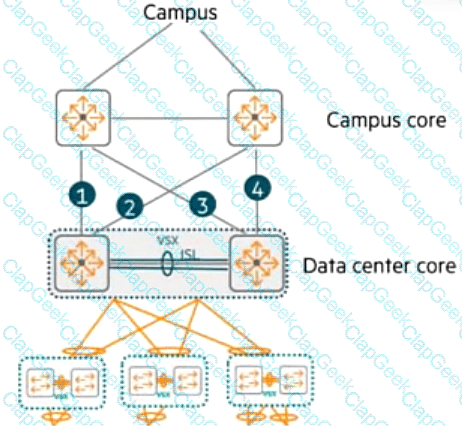
You are designing a data-center network. The customer requests connectivity between the data center and campus core switches. The customer uses VLANs for segmentation, but does not use VRFs.
What is the recommended design for the links between the data-center core switches and the campus core switches?
You have successfully installed, configured, and migrated the customer to the new Aruba CX data-center equipment.
Which documents are normally included in the post-installation deliverables?
Which statement correctly describes flow synchronization for HPE Aruba Networking CX 10000 Distributed Services Modules (DSMs) operating in VSX?
You have been asked to help design an HPE Aruba Networking CX network solution that connects AI servers to file storage. The solution must support NFS over RDMA and deliver 400 GbE links to the edge. The current design uses leaf and spine switches that carry all traffic in VXLAN tunnels. Every switch is a CX 9300-32D switch.
What is one correction you should make to the design?
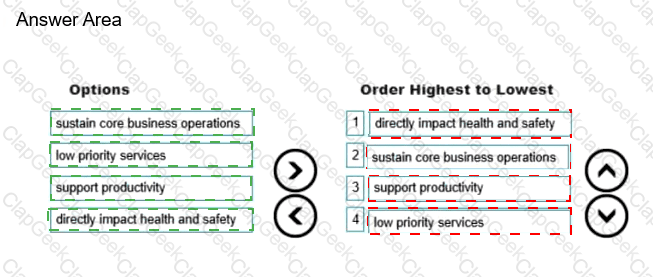
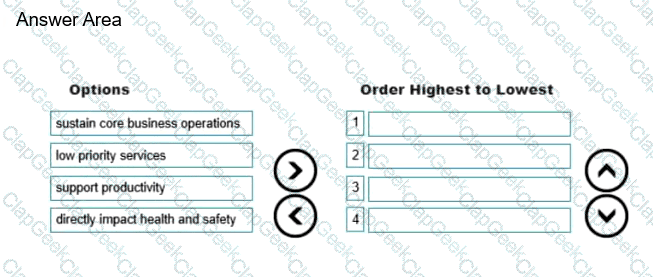
Order the severity levels (highest impact on top) into the righthand box.
Drag & Drop
Which information is likely to appear in the device-inventory deliverables? Choose two.
You are replacing the access layer in a customer data center network that uses VMware NSX. The customer has identified several subnets outside the VMware platform for which the customer wants to add overlay routing.
What high-level plan will work for this customer?
You are planning a network upgrade for a VMware-virtualized data center. The customer already uses NSX. You are responsible for the CX switch design, and the customer is responsible for the NSX design.
What is one topic to discuss for the logical design?
Refer to the rack requirements in the scenario. What additional information would help you select between the CX 8325-48Y8C and CX 8360-48Y6C models?




TESTED 15 Nov 2026