clapgeek logo

The current IT staff is accustomed to working with legacy OS-S (ProCurve) equipment. They are concerned that the differing command syntax will prevent them from handling OS-CX switches.
Which two methods can make their transition easier? (Select two.)
Choose two.
You are meeting with different stakeholders in a customer’s IT organization as part of an HPE Aruba Networking campus access-layer design project. You need to collect technical input that supports design decisions, including switch-port capacity, uplink requirements, and user-connectivity needs.
Which two stakeholders participate in these design activities?
Choose two.
You are planning a secure onboarding solution for a customer’s enterprise network. The plan includes HPE Aruba Networking ClearPass Policy Manager (CPPM) Onboard to simplify device onboarding and enforce security policies.
Which critical design considerations and feature recommendations should be included in your proposal to ensure a smooth, effective implementation?
Choose two.
You are creating a wireless intrusion detection and prevention strategy (WIDS/WIPS) for a client’s enterprise network with HPE Aruba Networking and AOS-10. As part of the design, you intend to deploy dedicated Air Monitors (AMs).
Which two statements are consistent with HPE Aruba Networking best practices for deploying AMs in an AOS-10 environment?
Choose two.
A large multinational financial institution has engaged you to design a new full-stack wired and wireless network for its new 6-story regional office building. The facility’s bottom two floors will be retail space for a large banking branch. The upper floors will be carpeted corporate office space, with each floor approximately 100,000 sq ft (9290 sq m). Data centers are all offsite and are outside this project’s scope. The customer is underserved by its current L2-based network infrastructure and wants to use modern best practices in the new design. The network must be fully resilient and fault-tolerant, with dynamic segmentation at the edge.
The retail space will provide public guest Wi-Fi access. Retail associates will use corporate tablets for customer service, and the retail floors will contain a mixture of wired and wireless devices. Corporate users will primarily connect wirelessly, although several wired clients, printers, and hard VoIP phones will be used.
The customer also plans to renovate the corporate office space to take advantage of ‘smart office’ technology. These upgrades will enable blue-dot wayfinding, presence analytics, and other location-based services.
After further discussions with the customer, the team determined that EVPN-VXLAN will provide dynamic segmentation. The customer wants to ensure that a particular VNI is present only when it is used on that switch.
Which solution is valid and meets this technical requirement?
Which statement is true regarding HPE Aruba Networking Central licensing for gateways?
You are responding to a customer’s Request for Proposal (RFP) for a new network-infrastructure solution. The RFP describes the customer’s desired features and technical outcomes but does not specify several important design details.
At this point in the proposal process, you must document the assumptions made to complete the design and address gaps in the RFP. These assumptions should represent reasonable expectations that guide the customer’s understanding of the solution and highlight areas that may require further clarification.
What is a valid example of an assumption that should be presented to the customer in your RFP response?
A global cruise line company must refresh its current fleet. It will refresh the ship’s “insides” to be cost-effective and improve sustainability, replacing all WLAN/LAN hardware. During this refresh, the company will not change its existing security requirements. The CIO also wants to minimize unused switch ports. Any future expansion will require a hardware refresh. They will begin with the smallest ship, with a maximum of 800 guests.
Each ship has a LAN infrastructure comprising two core switches, up to 10 redundant distribution switches, and up to 500 access switches (400 cabins and 100 technical rooms). The core switches are in the ship’s MDF, and the distribution switches are in the IDFs. Each cabin and technical room receives one individual access switch.
The ship’s cabling infrastructure will not be refreshed. Every IDF is connected to the MDF by SMF, with two pairs available for the interconnect between core and distribution. The SM fiber between the MDF and IDF is less than 300 meters (980 ft) long and is OS1. Each cabin is connected to the IDF by one OM2 pair, with a maximum length of 60 meters (200 ft). Each technical room is connected to the IDF by one OM2 pair, with lengths from 100 to 150 meters (320 to 500 ft).
For every cabin/technical room, the customer wants to replace the existing fan-less 2530/2540 switches without changing the requirements, except that the uplink to the distribution switch must be upgraded to 10GbE to accommodate increased network traffic, and the technical rooms require redundant power.
The WLAN infrastructure will be refreshed 1:1, with no new cabling or AP locations. The WLAN infrastructure uses 200/300 series indoor and outdoor APs running InstantOS (fewer than 300 APs), and the customer has no WLAN requirement changes.
The cruise line company will replace its existing Internet connection before the LAN/WLAN refresh. The new Internet connection will provide 99.8% uptime, required to keep paid guest Wi-Fi operational. With this new Internet connection, the CIO wants to base the design on Aruba’s ESP architecture because the Internet connection is guaranteed.
Based on best practices, what optic type should be recommended for the connection between the IDF and the technical rooms?
A colleague has produced a proposed design for a large enterprise customer that uses HPE Aruba Networking AOS-CX 6300 switches at the wired access layer. The customer requires a secure, scalable solution founded on Zero Trust Security (ZTS) principles.
In the current environment, endpoint devices connected to access switches are configured to transmit 802.1Q-tagged frames, and the new design plans to tunnel traffic from the switches to an AOS-10 Gateway cluster by using User-Based Tunneling (UBT) in its default mode.
During a design review, you are asked to determine whether this solution supports the customer requirement to retain endpoint VLAN tags across the tunnel.
You recommend a modification, explaining that the proposed default configuration will not satisfy the customer’s technical requirement.
Which UBT configuration would support the customer requirement to preserve VLAN tagging from the endpoints across the UBT tunnel to the gateway?
What is the basic difference between a main distribution framework (MDF) closet and an intermediate distribution framework (IDF) closet?
What is the recommended practice for using VSX at the core of a three-tier design?
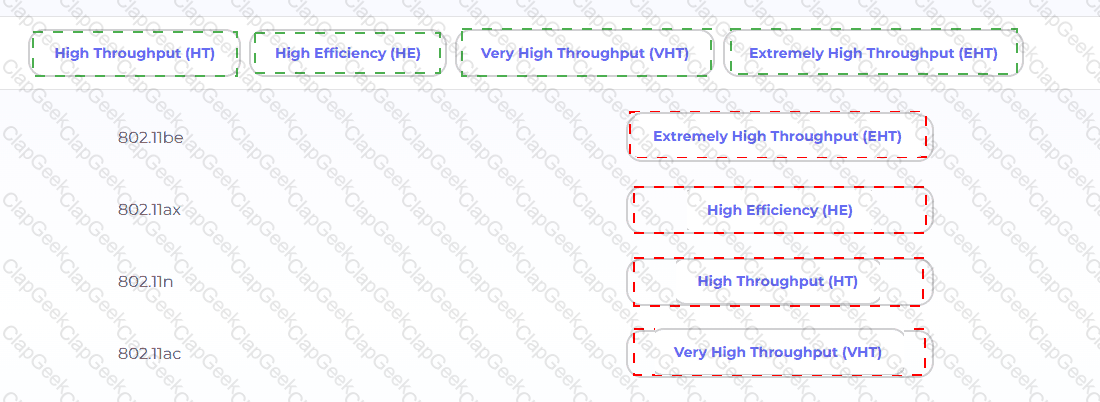
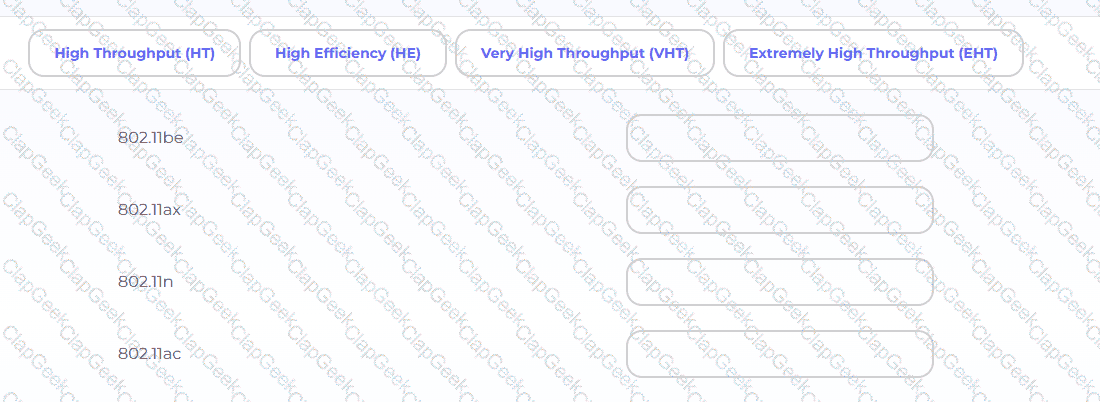
Match each IEEE designation with its official technical Physical Layer (PHY) protocol acronym.
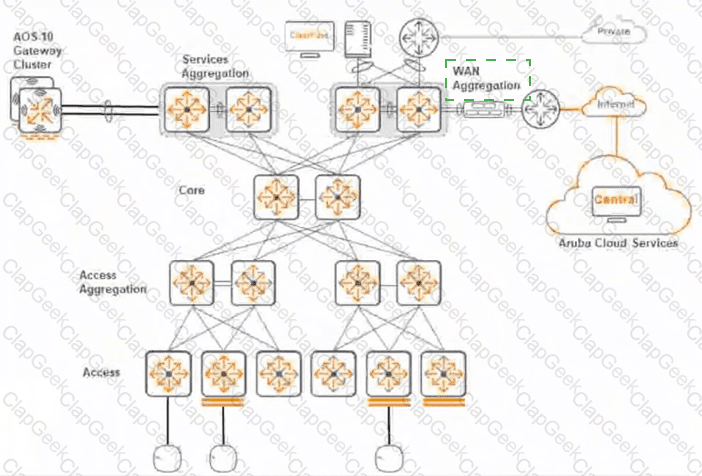
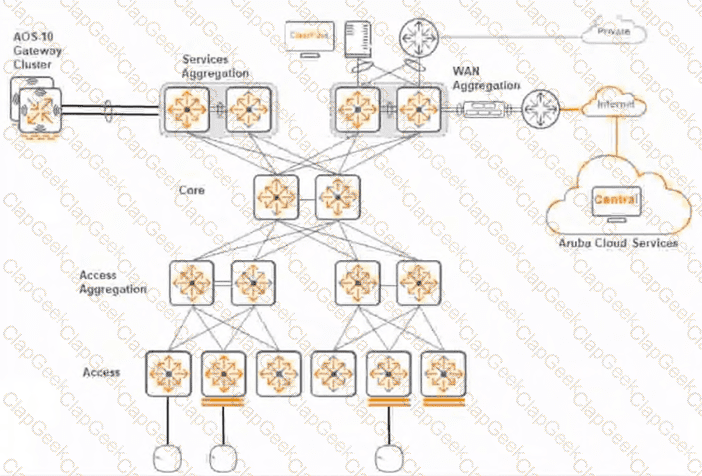
Based on this campus design, select the layer most suitable to be designed as a Border Persona when considering an EVPN VXLAN Fabric.
Original network architecture exhibit
Which documentation resources can be used to find validated information about HPE Aruba Networking products that helps the architect build the solution design?
Choose three.
A global cruise-line company needs to refresh its current fleet. It will refresh the ship’s internal infrastructure to be cost-effective and improve sustainability. It will replace all WLAN/LAN hardware on the ship. As part of this refresh, the company will not change its existing security requirements. The CIO also wants to minimize the number of unused switch ports. Any future expansion will always require a hardware refresh. The company will begin with the smallest ship, with a maximum of 800 guests.
Each ship has a LAN infrastructure comprising two core switches, up to 10 redundant distribution switches, and up to 500 access switches (400 cabins and 100 technical rooms). The core switches are in the ship’s MDF, and the distribution switches are in the IDFs. Each cabin and technical room receives a single access switch.
The ship’s cabling infrastructure will not be replaced. Each IDF connects to the MDF over SMF, with two pairs available for the interconnect between core and distribution. The SMF length between the MDF and IDF is less than 300 meters (980 ft), and it is OS1 fiber. Each cabin connects to its IDF with one OM2 pair, with a maximum length of 60 meters (200 ft). Each technical room connects to its IDF with one OM2 pair, with lengths from 100 to 150 meters (320 to 500 ft).
For every cabin and technical room, the customer wants to replace its current fanless 2530/2540 switches without changing the requirements, except that the uplink to the distribution switch must be upgraded to 10GbE to accommodate increased network traffic, and the technical rooms require redundant power.
The WLAN infrastructure will be refreshed 1:1, with no new cabling or AP locations. Its WLAN infrastructure uses 200/300-series indoor and outdoor APs running InstantOS (fewer than 300 APs), and the customer has no changes to WLAN requirements.
The cruise-line company will replace its existing Internet connection before the LAN/WLAN refresh. The new Internet connection will offer 99.8% uptime, needed to keep paid guest Wi-Fi continuously operational. With this new Internet connection, the CIO wants to base the design on Aruba’s ESP architecture because the Internet connection is guaranteed.
Based on best practices, what optic type should be recommended for the connection between the MDF and the IDFs?
An insurance company plans to modernize the current Wi-Fi 4 deployment in its downtown office building. At the time, the network was designed around a 2.4 GHz radio-coverage strategy. The company is targeting a high-throughput, high-density (HD) design to future-proof its investment. Your team is proposing a new site survey aligned with modern wireless design principles.
The CTO believes the site is ready for the Wi-Fi 6E standard or newer, referring to a site survey conducted four years ago. That same survey confirmed reuse of the existing cabling and current access-point installation locations.
Which statement about a 6 GHz design is correct?
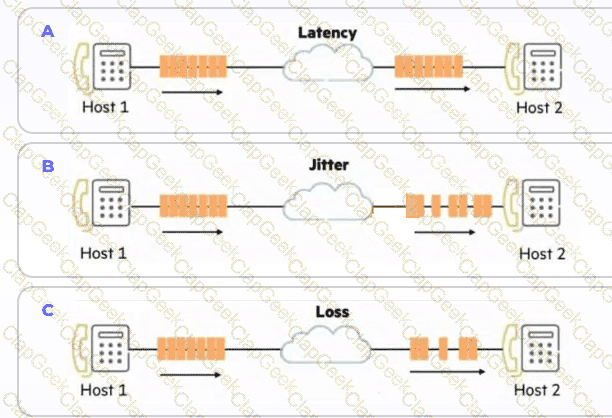
The client’s current network has occasional voice dropouts during phone calls between office locations. It has been determined that no packet loss is occurring, and QoS is the likely cause.
Which phenomenon is the client currently experiencing issues with?
Original exhibit — Question 36
A large multinational financial institution has engaged you to design a new full-stack wired and wireless network for its new 6-story regional office building. The facility’s bottom two floors will be retail space for a large banking branch. The upper floors will be carpeted corporate office space, with each floor approximately 100,000 sq ft (9290 sq m). Data centers are all offsite and are out of scope for this project. The customer is underserved by its current L2-based network infrastructure and wants to use modern best practices in the new design. The network must be fully resilient and fault-tolerant, with dynamic segmentation at the edge.
The retail space will provide public guest Wi-Fi access. Retail associates will use corporate tablets for customer service, with a mix of wired and wireless devices throughout the retail floors. Corporate users will mainly use wireless connectivity, although several wired clients, printers, and hard VoIP phones will also be used.
The customer also plans to renovate the corporate office space to take advantage of 'smart office' technology. These enhancements will enable blue-dot wayfinding, presence analytics, and other location-based services.
The client wants to provide Blue Dot wayfinding for its carpeted office space. The retail floors are not currently in scope.
What is required to ensure the solution is properly licensed?
Identify the stakeholders when collecting information for the network design and the new IDF/MDF design.
Choose two.
You are designing a solution with OS10-based access points and redundant gateways, with these requirements:
Wi-Fi6E-based access points
Support for tunneled traffic
Application visibility
Rogue APs
Live upgrades
Air Slice
Cloud Guest Authentication
AI Insights
Which licenses are required?
Choose two.
You are a member of a cross-functional team developing a detailed design proposal for a customer deploying EVPN-VXLAN in a modern campus core and data center fabric. The customer is moving from a traditional VLAN-based Layer 2 design to a VXLAN-based overlay architecture to support segmentation scalability and automation.
As the solution undergoes review, you are asked to contribute by identifying and explaining core technical behaviors and configuration considerations critical to the success of EVPN-VXLAN in this environment.
Which statements accurately describe key characteristics of EVPN-VXLAN in modern campus or data center networks?
You meet with a customer to update the network after the prior network manager has left the company for another role.
Which methods can validate the current network state when the available network documentation is invalid?
Choose two.
Refer to the exhibit.
Original HPE Aruba Networking SSE architecture exhibit
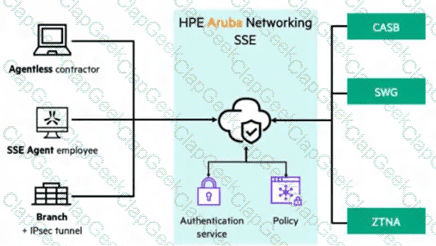
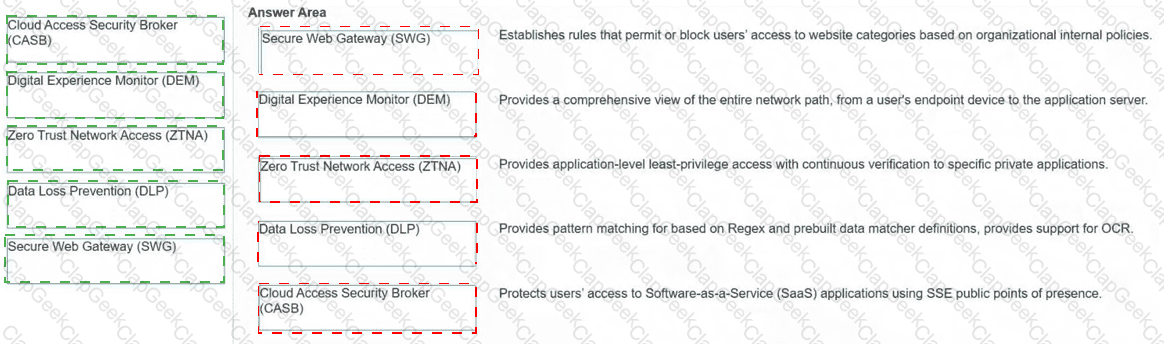
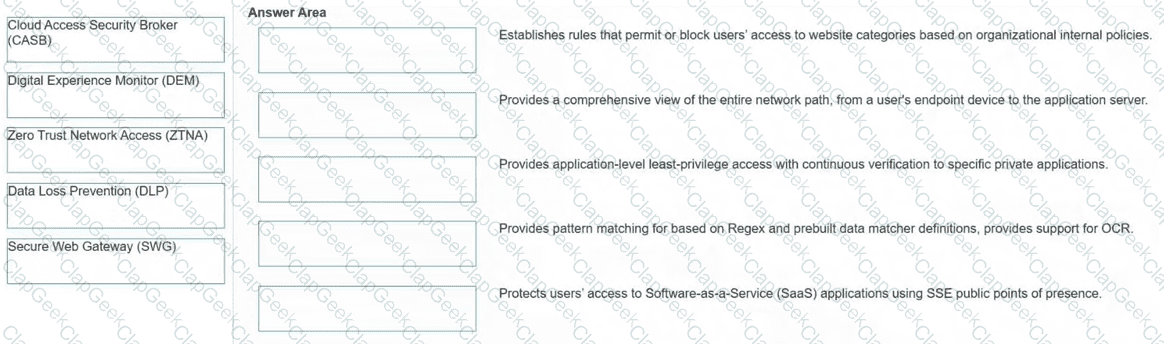
Match the HPE Aruba Networking (ANW) Secure Service Edge (SSE) cloud services with the appropriate descriptions.
XYZ Regional Hospital is an integrated healthcare system comprising hospitals, neighborhood health centers, and small doctor offices. XYZ Regional Hospital recently merged with 4x neighborhood health centers and 125 doctor branch offices. Its wireless, wired-access, and AAA solutions are outdated and must be replaced.
XYZ Regional Hospital wants to future-proof and improve efficiency across all sites by enhancing wired and wireless access and moving to centralized, unified wired/wireless and policy management that provides uninterrupted availability of all systems.
Locations:
XYZ Regional Hospital is in New York City.
Dila Health Center is in City A.
Mount Health Center is in City B.
Rock Health Center is in City C.
Branch clinics are in different locations across the United States.
Requirements:
Provide, through management software, a single pane of glass to manage wired and wireless LANs and VPNs across campus, branch, and remote locations through web/cloud architecture that delivers near-real-time insight, troubleshooting tools, and Service Level performance reporting.
Seamless integration across wired, wireless, WAN, SD-Branch, and IoT.
Provide secure wireless access for all Regional Hospital employees and partners, and provide wireless Internet access to medical citizens when they visit the facilities.
All access points must support these features and specifications: 802.11 ax (Wi-Fi 6E Certified).
Security options including WP2/WPA3 and 802.1X with Radius secure authentication.
Identify and authenticate every wireless and wired device.
End-to-end role-based security.
Seamless mobility throughout the hospital for medical teams, patients, and visitors.
Reduce Wi-Fi deployment time from days to hours and enable Zero-Touch deployments across the site.
Establish a resilient, future-ready network infrastructure with the intelligence, scalability, and intuitive toolsets to meet emerging needs.
A fully redundant branch solution with dynamic path selection to the hospital.
XYZ Regional Hospital recently acquired a new outpatient building 900 feet (275 meters) from the main hospital, with a clear line of sight but no feasible fiber connection between the buildings.
The design requirements are:
Extend the existing wireless SSIDs to the outpatient building.
Cloud-manage all wired and wireless devices across both buildings.
Which combination of products should the Network Architect recommend?
You are the lead network architect completing the Bill of Materials (BoM) for a new HPE Aruba Networking ClearPass Policy Manager (CPPM) deployment that must support the following environment:
3,000 wired IoT devices using MAC authentication.
2,000 wireless IoT devices using MPSK.
12,000 corporate laptops—a mix of Windows 11 Desktop PCs and Surface Pro devices—joined to Active Directory and authenticating through EAP-TLS, with posture assessments required through a ClearPass client agent.
1,000 BYOD users, each onboarding 2–3 personal devices and receiving certificates through ClearPass Onboard.
Up to 2,500 guest users per day, using ClearPass Guest with sponsor-based registration.
Which HPE Aruba Networking ClearPass license combination most accurately reflects what should be included in the IRIS-generated Bill of Materials to support this deployment?




TESTED 15 Nov 2026