clapgeek logo

A customer uses an AOS-10 architecture that includes HPE Aruba Networking APs. The customer recently enabled WIDS at the High level on the APs. Administrators observe many "detect disconnect station" events.
What should you explain?
Your company uses HPE Aruba Networking AOS-10 APs and gateways, along with AOS-CX switches, all managed through HPE Aruba Networking Central. In HPE Aruba Networking Central, you need to collect a packet capture for a client connected to an AP.
What is a prerequisite?
A company wants its AOS-CX switches to obtain certificates from ClearPass Onboard and use those certificates to implement RadSec with ClearPass Policy Manager (CPPM).
ClearPass Onboard has a CA with EST enabled and this EST URL: `[https://cp1.acnsxtest.com/.well-known/est/ca:2](https://cp1.acnsxtest.com/.well-known/est/ca:2)`
ClearPass Guest has an account whose username is `switchcorp123`. (Assume CPPM also has a valid service to authenticate users who access the EST application.)
CPPM has a network-device account for the switches with RadSec enabled. The RadSec settings validate by CN or SAN using this regex: `switchcorp123`
ClearPass has these certificates:
* HTTPS certificate signed by DigiCert
* RadSec certificate signed by DigiCert
* RADIUS/EAP certificate signed by MyDomainCA
This configuration is on the AOS-CX switches:
```text
crypto pki est-profile est1
url https://clearpass1.acnsxtest.com/.well-known/est/ca:2
username switchcorp123
password plaintext %FY212h & zaTk
vrf default
exit
crypto pki certificate cert1
subject switchcorp123
enroll est-profile onboard
crypto pki application radsec-client certificate cert1
```
The switches’ TA-profile list includes DigiCert.
Assume you have obtained the correct password associated with the indicated username. What error or errors are present?
An organization wants an AOS-CX switch to trigger an alert when its RADIUS server (cp.acnsxtest.local) rejects an unusual number of client authentication requests each hour. After discussions with other HPE Aruba Networking administrators, you still do not know how many rejections are normal or unusual. You expect the value might differ on every switch.
You are helping the developer understand how to create an NAE script for this use case.
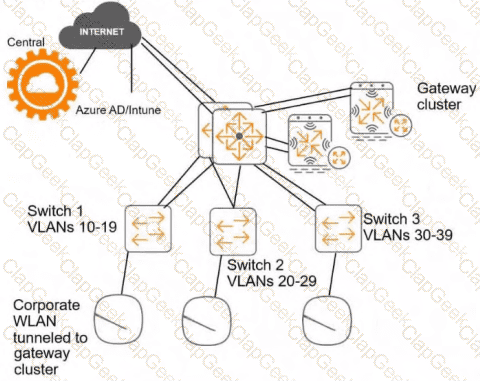
Refer to the scenario.
The developer explains that they intend to define the rule with logic like this: `monitor > value`
However, the developer asks what value to include.
What should you recommend?
You are helping a company add HPE Aruba Networking ClearPass to its network, which uses HPE Aruba Networking infrastructure devices.
The company already has a Windows domain and Windows CA. The Windows CA issues certificates to domain computers, domain users, and servers such as domain controllers.
ClearPass cluster IP addressing and hostnames
Publisher = 10.47.47.5
Subscriber 1 = 10.47.47.6
Subscriber 2 = 10.47.47.7
Virtual IP with Subscriber 1 and Subscriber 2 = 10.47.47.8
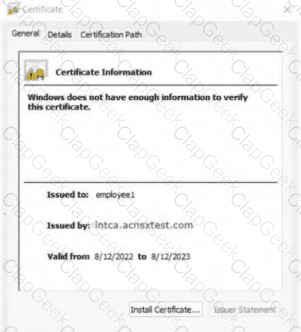
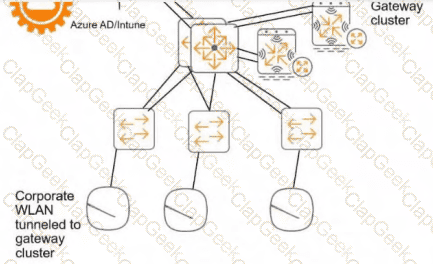
Refer to the scenario.
You have begun creating a CA to meet the customer's requirements for issuing certificates to mobile clients, as shown in the exhibit below.
Certificate Authority Settings:
Name: Exam Onboard CA
Mode: Root CA
Authority Info Access: Do not include OCSP Responder URL
Validity Period: 365 days
Clock Skew Allowance: 15
Subject Alternative Name: [X] Include device information in TLS client certificates
Digest Algorithm: SHA-512
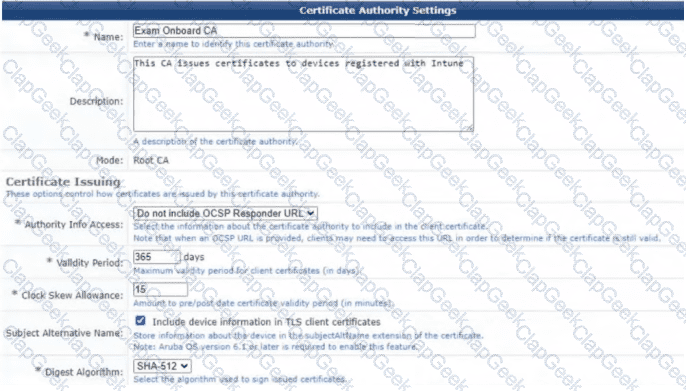
What change will help meet those requirements and the requirements for authenticating clients?
What benefit does an organization obtain by upgrading wireless security from WPA2-Personal to WPA3-Personal?
A hospital has an AOS-10 architecture managed by HPE Aruba Networking Central. The customer has deployed a pair of HPE Aruba Networking 9000 Series gateways with Security licenses at each clinic. The gateways implement IDS/IPS in IDS mode.
The Security Dashboard shows several recent events with the same signature, as shown below:
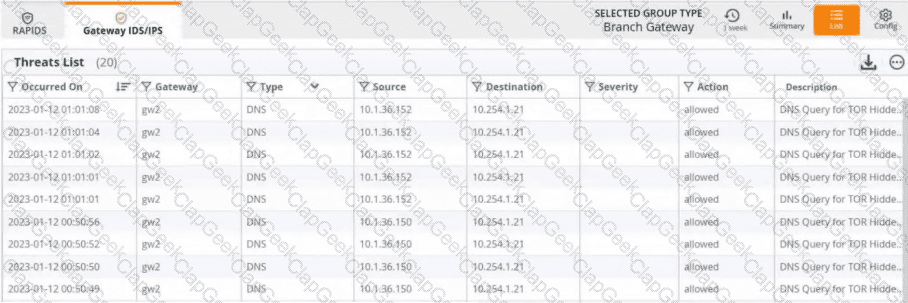
Occurred On: 2023-01-12 | Gateway: gw2 | Type: DNS | Source: 10.1.36.152 | Destination: 10.254.1.21 | Action: allowed | Description: DNS Query for TOR Hidden...
Refer to the scenario.
You have learned that nurse call stations are the source of the events. What can you conclude?
Refer to the exhibit.
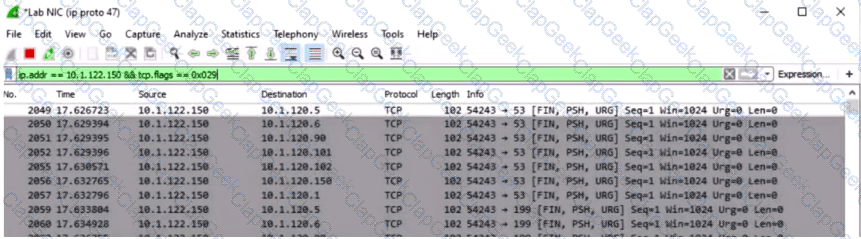
Packet trace display:
Source: 10.1.122.150 - > Destination: 10.1.120.5 TCP 54243 - > 53 [FIN, PSH, URG] Seq=1 Win=1024 Urg=0 Len=0
Source: 10.1.122.150 - > Destination: 10.1.120.6 TCP 54243 - > 53 [FIN, PSH, URG] Seq=1 Win=1024 Urg=0 Len=0
Source: 10.1.122.150 - > Destination: 10.1.120.90 TCP 54243 - > 53 [FIN, PSH, URG] Seq=1 Win=1024 Urg=0 Len=0
Source: 10.1.122.150 - > Destination: 10.1.120.101 TCP 54243 - > 53 [FIN, PSH, URG] Seq=1 Win= 1024 Urg=0 Len=0
Source: 10.1.122.150 - > Destination: 10.1.120.5 TCP 54243 - > 199 [FIN, PSH, URG] Seq=1 Win=1024 Urg=0 Len=0
What does this indicate?
Refer to the scenario.
A customer uses an AOS-10 architecture managed by HPE Aruba Networking Central. HPE Aruba Networking infrastructure devices authenticate clients to an HPE Aruba Networking ClearPass cluster.
In HPE Aruba Networking Central, you are reviewing network traffic flows for a wireless IoT device categorized as a “Raspberry Pi” client. You observe SSH traffic. You then examine several additional wireless IoT clients and find that they are also sending SSH.
You want a relatively easy way to communicate to HPE Aruba Networking CPPM that an IoT client has used SSH.
What is one prerequisite?
Refer to the scenario.
A customer has AOS-CX switches with this configuration on their edge ports:
port-access onboarding-method concurrent enable
aaa authentication port-access mac-auth enable
quiet-period 60
aaa authentication port-access dot1x authenticator enable
The switch authenticates clients to HPE Aruba Networking ClearPass Policy Manager (CPPM), which has these services:
An 802.1X service that uses an EAP-TLS method for most clients
A MAC-Auth service that uses the [MAC-Auth] method for devices such as printers imported from an inventory manager
The customer now wants to give limited access to wired guest devices and new devices that must be enrolled with certificates. You have configured these rights in an AOS-CX role named "guest-login."
How should the "guest-login" role be applied on the switches?
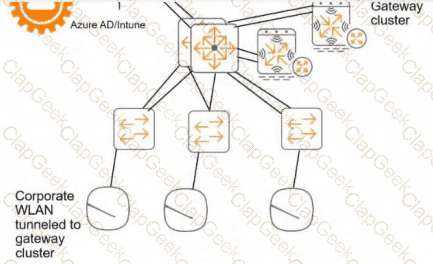
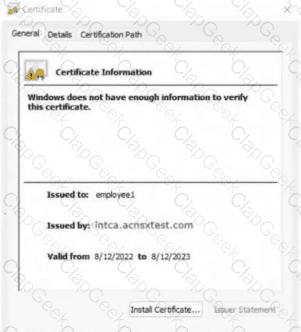
A customer operates two AOS-10 HPE Aruba Networking gateways at a site. The gateways are part of an SD-Branch solution managed by HPE Aruba Networking Central, and their cluster setting uses WLAN mode (the non-default gateway mode).
You are configuring a manual HPE Aruba Networking gateway cluster for dynamic authorization. The gateways have these IP addresses on a subnet that CPPM can access:
Gateway 1 = 10.56.20.2
Gateway 2 = 10.56.20.3
Which VRRP IP address assignments are valid for the gateways? Assume that all IP address options are available.
A customer has an AOS-10 architecture managed by HPE Aruba Networking Central. HPE Aruba Networking infrastructure devices authenticate clients through an HPE Aruba Networking ClearPass cluster.
In HPE Aruba Networking Central, you are reviewing network traffic flows for a wireless IoT device categorized as a “Raspberry Pi” client. You observe SSH traffic. You then inspect several additional wireless IoT clients and find that they are also sending SSH traffic.
Refer to the scenario.
You are assisting the customer in evaluating ways to mitigate the potential threat detected. One possible option has been identified: add a rule to the clients’ AOS user role that matches SSH traffic and applies denylisting.
What is one benefit of this option?
You must install a certificate on a standalone HPE Aruba Networking Mobility Controller (MC). The MC must use the certificate for the Web UI and to implement RadSec with HPE Aruba Networking ClearPass Policy Manager. You have received a certificate with these settings:
Subject: CN=mc49.site30.example.com
No SANs
Issuer: CN=ca89.example.com
EKUs: Server Authentication, Client Authentication
What problem does this certificate have for its intended uses?
A company uses an HPE Aruba Networking AOS-10 mobility infrastructure. Network administrators recently enabled wireless detection on the APs, which checks for all infrastructure and client threats. However, the administrators quickly became overwhelmed and now want to disable most checks.
They want a recommendation for the checks most likely to indicate genuine threats.
Which one should be mentioned?
A customer has an AOS-10 architecture that includes HPE Aruba Networking APs. The customer recently enabled WIDS at the high level on the APs. Administrators see several "ad hoc using valid SSID" events.
What should you explain?
The customer needs a secure wireless solution that lets users onboard new wireless clients. You are recommending a new WLAN that will give users limited access for this process.
Which WLAN security should you recommend, assuming users have a mixture of WPA2- and WPA3-capable devices?
A customer uses an AOS-10 architecture managed by HPE Aruba Networking Central. HPE Aruba Networking infrastructure devices authenticate clients to an HPE Aruba Networking ClearPass cluster.
In HPE Aruba Networking Central, you are reviewing network traffic flows for a wireless IoT device categorized as "Raspberry Pi" clients. You observe SSH traffic. You then examine several additional wireless IoT clients and find that they are also sending SSH.
Refer to the scenario.
You need a fast way to find a list of all IoT clients that have used SSH.
What step can you take?
Refer to the exhibit.
An administrator has configured a remote mirror between an AOS-CX switch and a station running a protocol analyzer. The exhibit displays a sample of the packet capture.
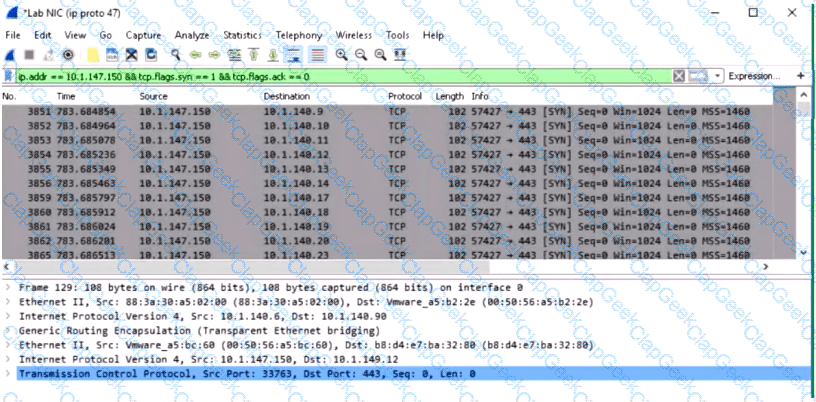
Packet trace details:
Source: 10.1.147.150 - > Destination: 10.1.140.9 TCP 57427 - > 443 [SYN] Seq=0 Len=0
Source: 10.1.147.150 - > Destination: 10.1.140.10 TCP 57427 - > 443 [SYN] Seq=0 Len=0
Source: 10.1.147.150 - > Destination: 10.1.140.11 TCP 57427 - > 443 [SYN] Seq=0 Len=0
Source: 10.1.147.150 - > Destination: 10.1.140.12 TCP 57427 - > 443 [SYN] Seq=0 Len=0
Source: 10.1.147.150 - > Destination: 10.1.140.13 TCP 57427 - > 443 [SYN] Seq=0 Len=0
Packet encapsulation tree shows Generic Routing Encapsulation (Transparent Ethernet bridging).
Which characteristic is suspicious?




TESTED 19 Nov 2026