
Pre-Summer Sale 70% Discount Offer - Ends in 0d 00h 00m 00s - Coupon code: clap70

CPXP Certified Patient Experience Professional Questions and Answers

Questions 4

Which of the following play a preeminent role in molding strategic targets, resource allocation, and performance monitoring plans that support an organization ' s vision?

Options:

A.

Organizational behavior management

B.

Performance coaching

C.

Strategic analytics

D.

Organizational policies and procedures

Buy Now
Questions 5

Which of the following is considered a complaint?

Options:

A.

A report by a patient of abuse

B.

A comment on a survey that could have been handled by staff

C.

A written letter about neglect by a caregiver

D.

An email that requires a formal investigation

Buy Now
Questions 6

Which should be the FIRST step in implementing a bedside shift report as a new process?

Options:

A.

Providing education to staff about how to do shift report at the bedside

B.

Mandating the expectation that shift report must occur at the bedside every time

C.

Establishing with staff why they need to change their current practice

D.

Having nurses commit in writing that reports will occur at the bedside

Buy Now
Questions 7

After providing information to a patient or care partner, what can BEST help assess for understanding or adherence?

Options:

A.

Empathy statement

B.

Open-ended questions

C.

Teach-back technique

D.

Survey responses

Buy Now
Questions 8

Which is the MOST effective example of staff recognition?

Options:

A.

Reading a positive patient letter during a town hall meeting

B.

Sharing positive patient comments in the organization’s newsletters

C.

Posting patient experience scores in public areas for everyone to see

D.

Thanking the staff for their efforts during a personal visit from the senior leader

Buy Now
Questions 9

Which steps are contained in the first phase of experience mapping?

Options:

A.

Prioritize and create storyboards.

B.

Tell and sketch the story.

C.

Conduct data gathering.

D.

Identify moments of truth.

Buy Now
Questions 10

Which is the BEST description of a histogram?

Options:

A.

A continuous line that represents the frequencies of scores within a class interval

B.

A visual representation of the frequency distribution where the frequencies are represented by bars

C.

A chart with categories organized vertically on the y-axis and values shown horizontally on the x-axis

D.

A chart that shows the proportion of an item that makes up a series of data points

Buy Now
Questions 11

Which of the following is the MOST effective team structure to improve the patient experience around pain management?

Options:

A.

Physician representatives and pain management specialists

B.

Director of pharmacy, patient experience leader, and nursing leadership

C.

Representatives from the nursing staff and the unit director

D.

Front-line nursing and pharmacy staff, directors, and physician representatives

Buy Now
Questions 12

Which option is BEST used to understand an individual’s patient experience within a healthcare organization?

Options:

A.

Patient and family advisory council

B.

Patient focus group

C.

Patient complaint

D.

Patient shadowing

Buy Now
Questions 13

Which is a PRIMARY benefit of using focus groups?

Options:

A.

Generating one central point of consensus

B.

Identifying or confirming deeper meaning behind facts

C.

Analyzing survey data to determine longitudinal trends

D.

Gathering input on executive hiring decisions

Buy Now
Questions 14

Which is the BEST approach to obtaining employee commitment to a new process or initiative designed to improve the patient experience?

Options:

A.

Have managers monitor and measure the process.

B.

Provide incentives to managers for implementation success.

C.

Explain at the start of implementation why the change is occurring.

D.

Involve staff in the design and development of the process.

Buy Now
Questions 15

Which is a central role for an effective facilitator?

Options:

A.

Identifies the most useful suggestions from the group

B.

Guides the discussion to avoid conflict among participants

C.

Creates and sustains a participatory environment

D.

Encourages the group to focus on outcomes

Buy Now
Questions 16

How should a culturally skilled healthcare professional approach the patient and family relationship?

Options:

A.

Treat the patient and family as unique personas and further assess social and cultural context.

B.

Engage the patient and family and put their wishes first.

C.

Show formal respect, but apply best professional judgment.

D.

Understand and respect the cultural and social patterns of the given ethnic group.

Buy Now
Questions 17

Which is the MOST effective use of real-time data collection?

Options:

A.

Shaping organizational strategy

B.

Providing opportunity for immediate recognition

C.

Identifying patterns and trends for organizational change

D.

Revealing needed facility-wide improvements

Buy Now
Questions 18

Which of the following is a core element to facilitating a focus group?

Options:

A.

The group has a trained moderator.

B.

The group discusses multiple topics.

C.

The group generates quantitative information.

D.

The group includes a minimum of 25 people.

Buy Now
Questions 19

What is the BEST way to immediately address any type of patient experience failure?

Options:

A.

Kaizen events

B.

Capture complaints

C.

Grievance letters

D.

Service recovery

Buy Now
Questions 20

An increasing number of patients and family members believe that their treatment plans are wrong. Unit leaders report high census, staffing challenges, and difficult patient behaviors. What is the FIRST step a patient experience professional should take to address this situation?

Options:

A.

Create communications training for front-line staff and physicians.

B.

Seek additional information by reaching out to patients and families to ask about their involvement in the care process.

C.

Work with unit leaders to develop and add a custom question to the patient experience survey.

D.

Seek additional information by reaching out to friends and colleagues who have been patients and ask whether they have had similar experiences.

Buy Now
Questions 21

Which is the MOST important element in achieving an exceptional patient experience?

Options:

A.

Financial resources

B.

Community engagement

C.

Employee engagement

D.

Technological advances

Buy Now
Questions 22

Significant differences between what end-users may desire and what healthcare systems are willing to do based on their expertise and resources is a challenge for design-thinking. What is the BEST strategy below to help bridge the gap and provide balance?

Options:

A.

Empathy for end-user desires, a clear awareness of current state experiences, and identification of issues that can interfere

B.

Needs assessment based on observational data and interviews, ideation, and prototyping

C.

Review of system budget and resources, identification of solution, implementation, and 6- month check

D.

Staff interviews and PDCA cycle implementation

Buy Now
Questions 23

How can patient experience survey results BEST be used to influence organizational efforts?

Options:

A.

Analyze organizational and unit-level performance to monitor and follow up on performance.

B.

Align behaviors to survey results throughout the organization to drive desired outcomes.

C.

Recognize and reward outstanding behaviors that drive desired results.

D.

Establish clear goals, align behaviors, and consistently review performance.

Buy Now
Questions 24

Which is the BEST example of an employee engagement strategy?

Options:

A.

Sharing patient letters in an organizational newsletter

B.

Reviewing employee satisfaction data with individual units/departments

C.

Demonstrating appreciation for individual staff contributions

D.

Discussing complaint and grievance data during staff meetings

Buy Now
Questions 25

Which term describes patient experience survey data made up of comments?

Options:

A.

Anecdotal

B.

Quality

C.

Qualitative

D.

Quantitative

Buy Now
Questions 26

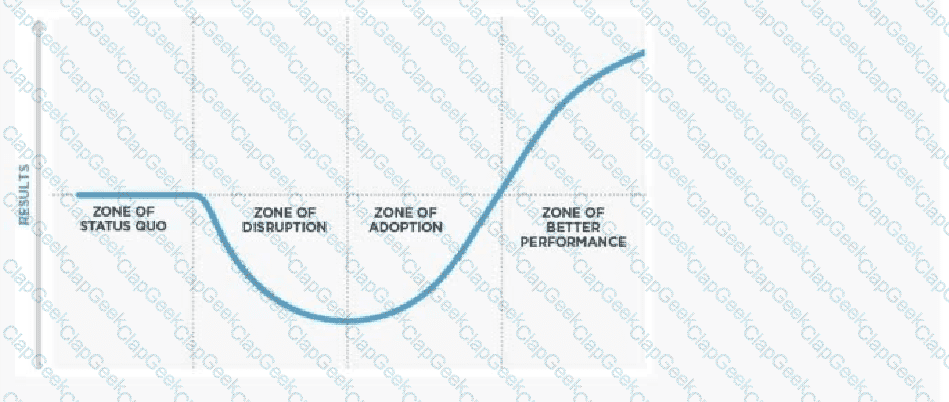
Referencing the Change Model graph below, where in these zones does “The Point of Decision” usually occur?
Options:

A.

At the midpoint of the “Zone of Status Quo”

B.

In between the “Zone of Status Quo” and “Zone of Disruption”

C.

In between the “Zone of Disruption” and “Zone of Adoption”

D.

In between the “Zone of Adoption” and “Zone of Better Performance”

Buy Now
Questions 27

What measures the dispersion of the data set?

Options:

A.

Median

B.

Distance

C.

Mode

D.

Variance

Buy Now
Questions 28

Administrators voice concern that physicians in a medical practice group seem stuck at the same scores on patient experience surveys. What is the BEST next step for the patient experience professional to build engagement and move forward with improvement actions?

Options:

A.

Meet with medical practice leaders to learn their expectations and identify physician leaders within the practice.

B.

Publicly share individual physician patient experience scores and percentile rankings.

C.

Share improvement tips focused on communicating with patients.

D.

Work with the front-line team and survey vendor to improve survey response rates.

Buy Now
Questions 29

Which tactic is the BEST way to engage staff and gain buy-in?

Options:

A.

Provide employees training in improving the patient experience.

B.

Invite staff to participate in focus groups on improving patient experience.

C.

Create a mandate that all employees participate in improving the patient experience.

D.

Form a patient experience team with front-line staff to improve the patient experience.

Buy Now
Questions 30

A patient experience professional is meeting with a group of front-line nurses on a medical/surgical unit to identify why they are having difficulty hourly rounding on their patients. Which process improvement tool should be used to determine the root cause?

Options:

A.

A regression analysis

B.

A “5 Whys” exercise

C.

A Six Sigma control plan

D.

An inter-rater reliability tool

Buy Now
Questions 31

Which is the BEST way to de-escalate a situation in which a patient is acting in an agitated, aggressive manner?

Options:

A.

Maintain a smile.

B.

Stand close to the patient.

C.

Use short, simple sentences.

D.

Keep hands in pockets.

Buy Now
Questions 32

Which response is BEST to provide to a family member requesting to be present during a resuscitation?

Options:

A.

“I’m sorry, but we cannot have family present during patient resuscitation. This is to make sure you are not in the way of critical processes.”

B.

“I’m sorry, but only clinical team members are allowed to be present to ensure there are no distractions in our efforts to save your loved one’s life.”

C.

“You are welcome to stay. I will make sure someone is with you to explain what is happening and to support you.”

D.

“You are welcome to stay to witness this event, but please stay to the side to ensure you are not in the way of our efforts.”

Buy Now
Questions 33

Which is the MOST commonly reported cause of adverse events affecting limited English proficiency/culturally diverse patients?

Options:

A.

Professional interpreters are not adequately trained to translate in medically challenging situations.

B.

Family members, friends, and nonqualified staff are used as medical interpreters.

C.

Administrators fail to hire bilingual staff to fulfill appropriate language services.

D.

Staff overlook cultural nuances, creating assumptions that affect patient safety.

Buy Now
Questions 34

Which type of chart or diagram would be BEST to organize ideas that a team came up with during a brainstorming session?

Options:

A.

Flow chart

B.

Run chart

C.

Affinity diagram

D.

Venn diagram

Buy Now
Questions 35

When is the BEST time to do service recovery follow-up?

Options:

A.

Immediately after the issue arises

B.

24 hours after the issue arises

C.

After fully researching and validating concerns

D.

After discharge/appointment ends

Buy Now
Questions 36

What are the steps of the PDSA cycle?

Options:

A.

Perceive, design, scale, adapt

B.

Plan, do, study, act

C.

Prepare, direct, sustain, activate

D.

Prioritize, delegate, select, assess

Buy Now
Questions 37

Which is the MOST significant benefit when being transparent with a provider’s patient experience data?

Options:

A.

Encouraging competition among high performers

B.

Identifying top performers for the purpose of recognition

C.

Creating a sense of urgency and accountability for improvement

D.

Identifying where positive practices are occurring

Buy Now
Questions 38

What do patient feedback measures capture patient perceptions of?

Options:

A.

What and when things happened

B.

What and how frequently things happened

C.

Where and when things happened

D.

Where and how frequently things happened

Buy Now
Questions 39

Which statement BEST reflects The Beryl Institute’s definition of patient experience?

Options:

A.

The patient’s satisfaction score after discharge

B.

The sum of all interactions, shaped by an organization’s culture, that influence patient perceptions across the continuum of care

C.

The clinical outcome achieved during treatment

D.

The efficiency of registration, billing, and discharge processes only

Buy Now
Questions 40

In which stage of the ADKAR change management model would recognition efforts MOST LIKELY take place?

Options:

A.

Desire

B.

Ability

C.

Awareness

D.

Sustainment

Buy Now
Questions 41

Which of the following is an example of a process measure?

Options:

A.

Patient satisfaction

B.

Wait times for lab test results

C.

Rate of hospital-acquired infections

D.

Length of hospital stay

Buy Now
Questions 42

Which method is BEST used to engage patients and family members about their concerns and suggestions for improvement in a healthcare organization?

Options:

A.

Interview employees who have been patients.

B.

Hold quarterly patient and family focus groups.

C.

Conduct weekly point of care surveys.

D.

Establish a patient and family advisory council.

Buy Now
Questions 43

Which of the following BEST describes four core concepts of patient- and family-centered care?

Options:

A.

Safe care, high quality care, optimal experience/satisfaction, and value

B.

Dignity and respect, information sharing, collaboration, and participation

C.

Patient experience, population health, cost reduction, and employee engagement

D.

Patient engagement, family support, relationship-based care, and efficiency

Buy Now
Questions 44

Which strategy BEST demonstrates an effective integration of patient and family advisors?

Options:

A.

Hosting a reception for patient and family advisors to meet hospital executive leadership

B.

Utilizing patient and family advisors as members of interview panels for hospital key leadership positions

C.

Inviting families in the hospital or hospital board members who have been patients to join the patient and family advisory council

D.

Presenting completed plans for newly designed patient rooms to the patient and family advisory council

Buy Now
Questions 45

A patient experience professional has been asked to participate in the formation of a patient and family advisory council (PFAC). What is the MOST appropriate first step to ensure that the goals of this responsibility are fulfilled?


Options:

A.

Review patient satisfaction comments in order to solicit ideas for the formation of the PFAC.

B.

Engage currently admitted patients and families to obtain ideas on next steps for the formation of the PFAC.

C.

Present the idea to unit-based staff for their input, taking into consideration feedback that they have obtained from their own professional experiences.

D.

Read available literature and consult with other organizations who have successfully implemented patient and family advisory committees.

Buy Now
Exam Code: CPXP
Exam Name: Certified Patient Experience Professional
Last Update: Apr 18, 2026
Questions: 150
CPXP pdf

CPXP PDF

$25.5  $84.99
CPXP Engine

CPXP Testing Engine

$30  $99.99
CPXP PDF + Engine

CPXP PDF + Testing Engine

$40.5  $134.99