clapgeek logo

A storage administrator is being presented with the following VMware Cloud Foundation (VCF) architectural details:
• The applications data will require 2.5 PB of capacity.
• The production applications will be hosting archival solutions and gateways.
• There will be some applications deployed for the purpose of testing and development.
What is the optimal principal storage that the administrator can recommend?
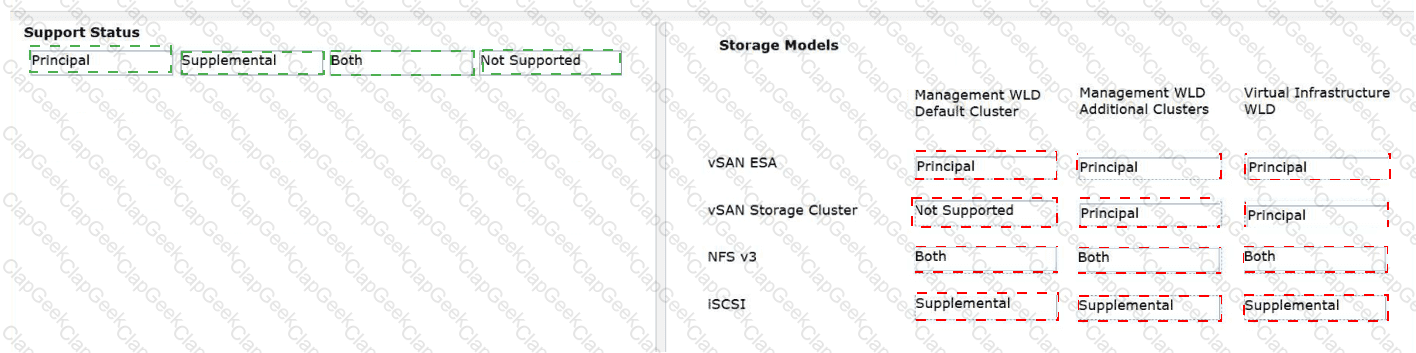
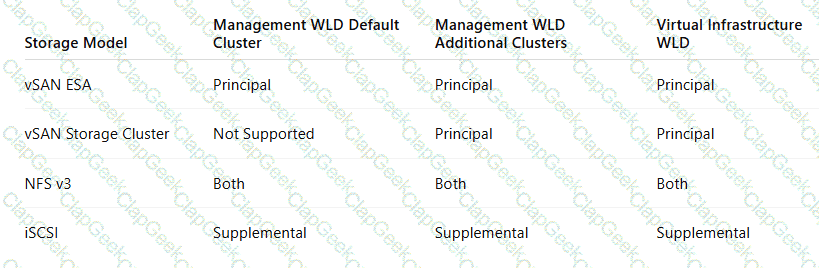
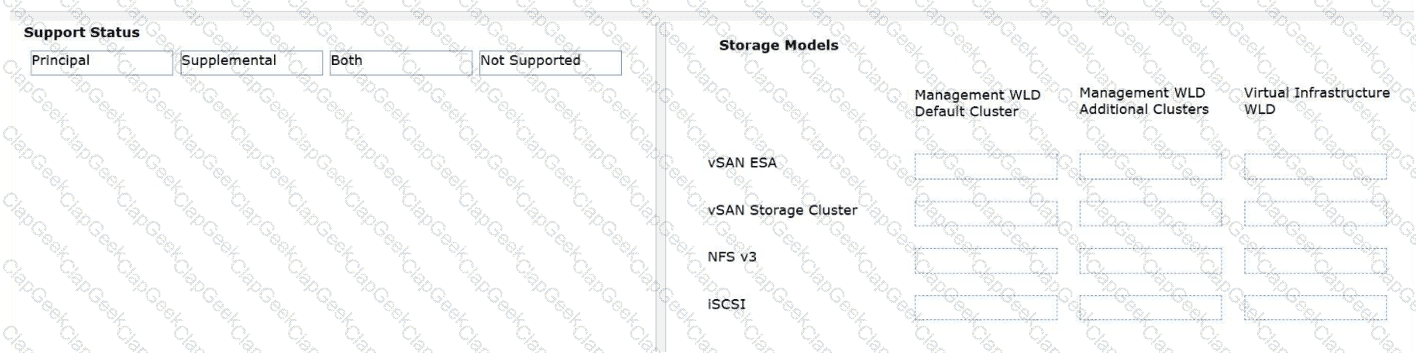
An administrator is responsible for a VMware Cloud Foundation (VCF) Private Cloud and has been tasked with identifying which storage model is supported in the different VCF Workload Domains.
Drag and drop the Support Status of each storage model on the left to each type of Workload Domain on the right.
A storage architect is designing a vSAN solution that enforces quotas and Access Based Enumeration (ABE) on all file shares.
What should the architect highlight as a design decision implication?
An architect is presented with the following requirements for the storage solution in a VMware Cloud Foundation (VCF) Workload Domain.
The solution must:
• Allow for rapid recovery in case of an availability zone failure.
• Provide an extremely high amount of IOPS to all applications.
• Allow for additional storage to be added as application needs grow.
• Provide the lowest latency possible for configured applications.
• Provide recovery in case of datastore failure.
• Encrypt data in transit and at rest.
What two vSAN advanced technologies must be deployed to meet these requirements? (Choose two.)
An enterprise is planning to deploy a new vSAN ESA enabled cluster to their existing VMware Cloud Foundation (VCF) Private Cloud Workload Domain. The following requirements have been given:
• 2 x 4 TB NVMe disks per host
• FTT=1/RAID-5 for all deployed Virtual Machines
• Expected dedupe/compression ratio = 1.5 (50%)
• Reserve enough capacity to rebuild a host completely in case of a failure (Host Rebuild Reservation)
• Operational Reserve of 10%
• Expected overhead for filesystem, object, etc. of 25%
How many hosts are required to meet a minimum usable capacity of 12 TB?
A financial organization successfully deployed a new Workload Domain in VMware Cloud Foundation (VCF) using NFS storage. All ESX hosts are commissioned and connected to the same storage network. The system administrator is tasked to configure a new NFS datastore in the existing cluster.
Which two steps are correct? (Choose two.)
An administrator is tasked designing a vSAN storage solution while respecting the following requirements:
• Must use vSAN ESA
• Must be stretched between two data centers
• Must configure Failures to tolerate = 1
• Must configure Erasure Coding
How many components per Virtual Machine (VM) will be created?
An administrator is monitoring a vSAN ESA backed workload domain that is dedicated for running AI inferencing. When the administrator navigates to the Storage Performance dashboard in VMware Cloud Foundation Operations, the performance dashboard shows:
• High backend write latency ( > 8 ms)
• Low read latency ( < 1 ms)
• Normal network throughput
• Disk Group Health = Green
Based on the readings above, what would be the explanation?
A VMware Cloud Foundation (VCF) environment runs mixed workloads (Online Transaction Processing (OLTP) + analytics), with the following vSAN configuration:
• 8 hosts (all-flash), ESA enabled.
• Each host: 2 x 3.2 TB NVMe devices.
• Compression is Enabled.
• Checksum is Enabled.
• Storage Policy: FTT=1 (RAID-5/6), Failures to Tolerate = 1 and Object Space Reservation = 0%.
During peak OLTP load, vSAN resync I/O and backend congestion increase latency despite having sufficient network bandwidth.
What is the direct action the administrator can perform to improve write performance while maintaining data protection compliance?
A customer attaches an external Fibre Channel (FC) VMFS datastore to a VMware Cloud Foundation (VCF) workload domain for backup staging. The administrator must confirm that the datastore is visible to all hosts, and that path and device health alarms will trigger should a fabric link or path fail.
Which action should the administrator take to verify this?
An administrator has been tasked with deploying vSAN Data Protection in a VMware Cloud Foundation (VCF) Workload Domain. The administrator deploys the VMware Live Recovery OVA and logs into the management interface to start the Configure Appliance process, but the appliance fails to register with vCenter.
What are two possible causes the administrator can check to resolve the issue? (Choose two.)
A clustered legacy application is scheduled for decommissioning at the end of the month. While in use, it stored application and quorum data on a pair of vSAN iSCSI Target LUNs.
After the vSAN iSCSI Target Service is disabled, what will happen to the existing targets and LUNs?
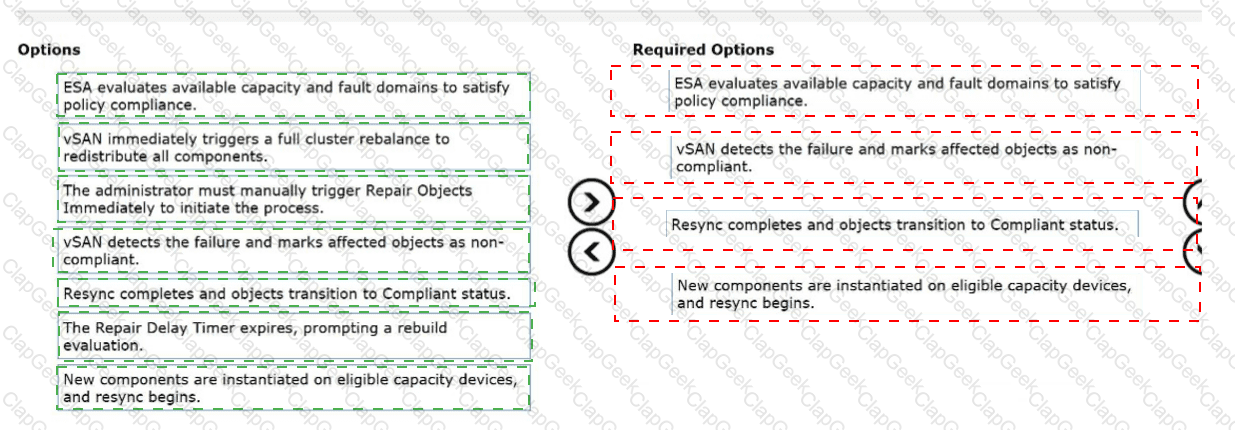
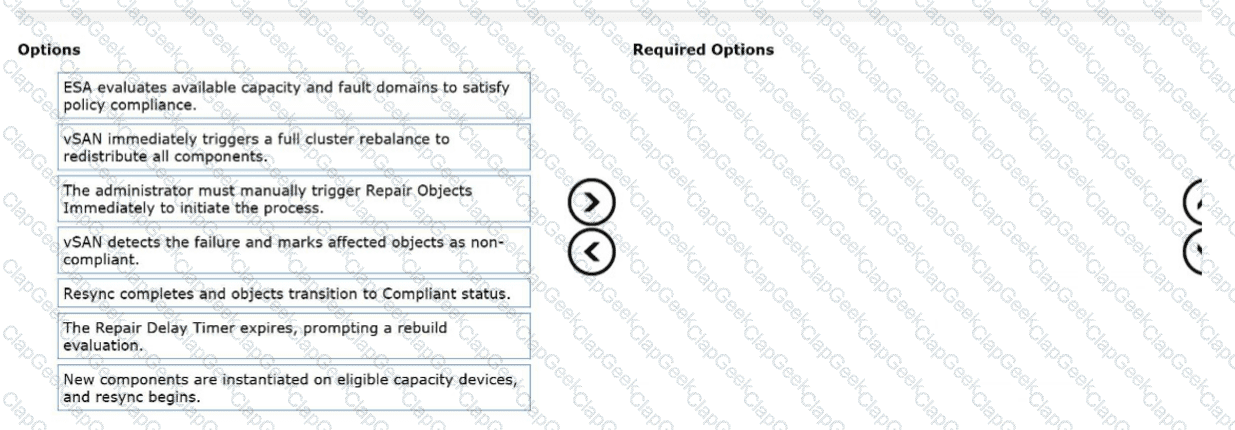
A vSAN ESA cluster experienced a host NVMe failure, causing several objects to become non-compliant.
Select the steps vSAN ESA follows to detect, evaluate and repair the non-compliant objects.
Drag and drop the four correct options from the Options list on the left and place them into the Required Options on the right in any order. (Choose four.)
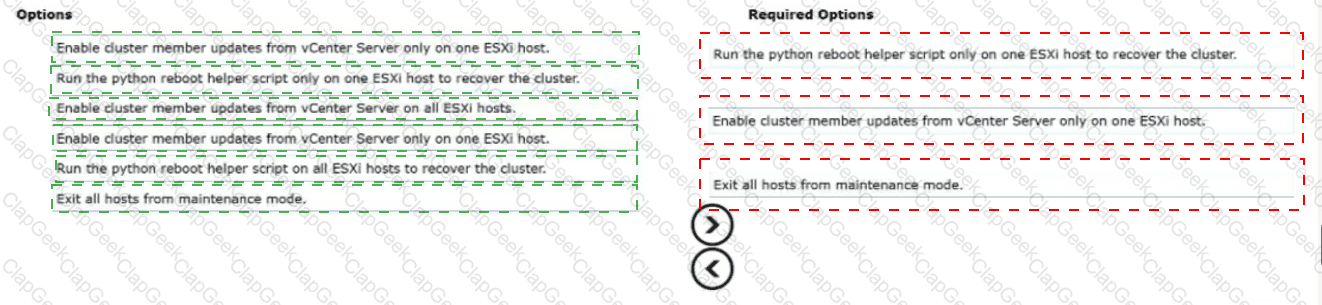
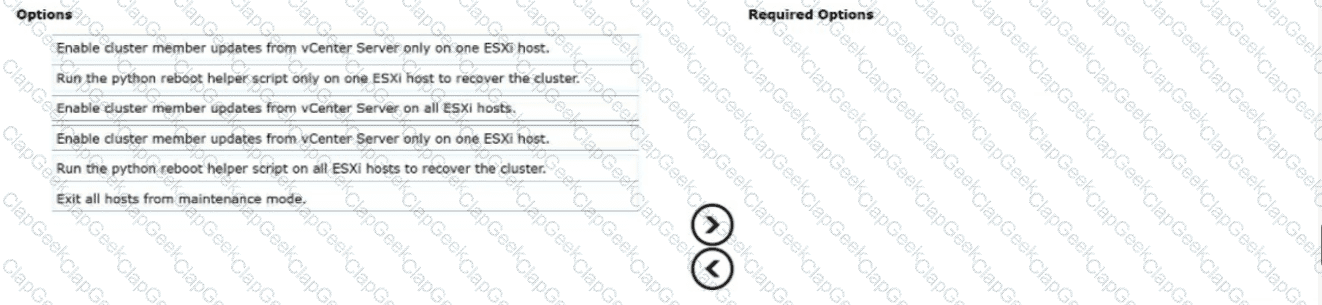
After a planned power outage, an administrator decided to restart the vSAN cluster manually.
Drag and drop the three correct options from the Options list on the left and place them into the Required Options on the right in any order. (Choose three.)
An architect is designing a vSAN storage solution for a remote site. The following requirements have been given:
• There is enough rack space for two hosts, each with 36 CPU cores and 256 GB of RAM.
• The physical network at the remote site supports 10 Gb maximum.
• The network connecting the remote site to corporate has 10 Gb of bandwidth with an average RTT of 25 ms.
• High availability is expected for all the Virtual Machines running at the remote site.
• The solution must provide additional storage to 16 graphic design Windows based workstations.
• Active Directory is configured and available at the remote site.
• The graphic design application requires native NTFS permissions.
What vSAN advanced technology is required for configuring this remote site?
A cache drive failed on one of the vSAN OSA nodes in the cluster.
When the drive failed, vSAN started a resync to ensure the health of the data, and all objects are showing a healthy and compliant state.
The vSAN administrator needs to replace the failed cache drive.
Which set of steps should the vSAN administrator take?
To respect the application criticality, an administrator is configuring the Recovery Priority of protected Virtual Machines (VMs).
What does VMware Live Site Recovery leverage to mark a recovery priority as completed?
An administrator is managing a stretched vSAN ESA cluster where each site has three hosts.
The following parameters apply to the storage policy being configured at the datastore level:
• The policy is configured at the datastore level
• Site disaster tolerance = Site mirroring - stretched cluster
• Failures to tolerate = 1 failure - RAID-1 (mirroring)
• Number of disk stripes = 1
When inspecting some of the Virtual Machines (VMs), why do objects have 3 disk stripes?
An administrator has successfully deployed a vSAN Stretched Cluster and needs to ensure that any Virtual Machines (VMs) that are created are placed in the appropriate site.
Which two steps are required to complete the task? (Choose two.)




TESTED 06 Oct 2026